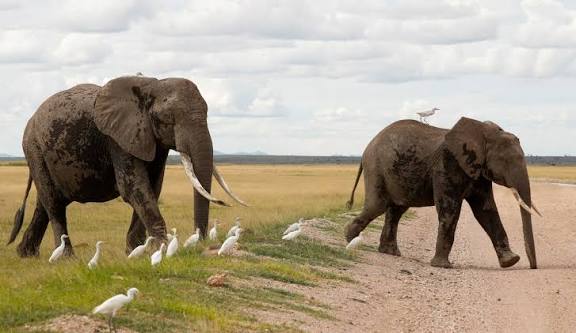
Kenyan authorities have arrested four people as part of an investigation into the deaths of 18 elephants across the Amboseli ecosystem, raising concerns about the safety of one of East Africa’s most important wildlife populations.
The investigation follows the deaths of elephants in Amboseli National Park, Kimana Sanctuary and the Kuku Ranch area.
Kenyan authorities have said preliminary laboratory findings indicate the possible involvement of a toxic substance, although investigators have not established criminal responsibility.
The scale of the deaths
The first 15 elephant deaths were recorded between June 24 and July 24.
Three additional deaths were later recorded, bringing the total to 18.
The animals reportedly displayed symptoms including partial paralysis before dying within a short period.
The unusual pattern immediately raised concerns among wildlife officials and conservationists.
Elephants are among Kenya’s most important wildlife species.
They play an important role in the country’s tourism economy and are also considered a major conservation priority.
Possible poisoning
Preliminary evidence has pointed towards the possibility that the elephants consumed a toxic substance.
Investigators have considered whether pesticides used on farms bordering the national park could have played a role.
However, wildlife experts have expressed doubts about some of the initial explanations.
The absence of similar deaths among other animals in the area has raised questions about whether agricultural chemicals alone can explain the situation.
Authorities are therefore continuing their investigation.
Arrests do not establish guilt
Four people were arrested during the investigation but have since been released on bail.
Authorities have emphasised that the arrests and substances recovered during searches do not, by themselves, establish criminal culpability.
Investigators are also pursuing another individual believed to have information relevant to the case.
Chemicals and other substances were reportedly recovered during a search in the Tikondo area of Loitoktok sub-county.
The human-wildlife connection
The Amboseli ecosystem illustrates the complicated relationship between wildlife conservation and local communities.
Elephants do not remain permanently within national park boundaries.
They move across protected areas and community land.
In the process, they can destroy crops and damage farms.
This can create conflict between communities and wildlife.
Farmers may lose income when elephants enter agricultural areas.
At the same time, Kenya’s tourism sector depends heavily on the presence of wildlife.
This creates a difficult policy challenge.
Tourism implications
Wildlife tourism generates significant economic activity in Kenya.
International visitors travel to destinations such as Amboseli specifically to see elephants and other wildlife.
Tourism supports hotels, restaurants, guides, transport operators and local businesses.
A sustained decline in wildlife populations could therefore have economic consequences.
Conservation is consequently not only an environmental issue.
It is also a business and development issue.
The importance of the investigation
Determining what caused the deaths is critical.
If poisoning is confirmed, authorities need to identify the source.
They must also determine whether the poisoning was deliberate or accidental.
If agricultural chemicals are responsible, stronger controls may be required around protected areas.
If criminal activity is involved, law-enforcement action will become necessary.
Protecting Amboseli
The Amboseli ecosystem extends beyond the national park and includes community lands.
Protecting elephants therefore requires cooperation between government agencies, conservation organisations, farmers and local communities.
Better monitoring could help identify risks earlier.
Community education can also reduce the likelihood of accidental poisoning.
For now, authorities face the immediate task of identifying what killed the 18 elephants.
The outcome of the investigation could influence wildlife protection policies in Kenya and determine how the country manages the increasingly complex relationship between conservation, agriculture and tourism.