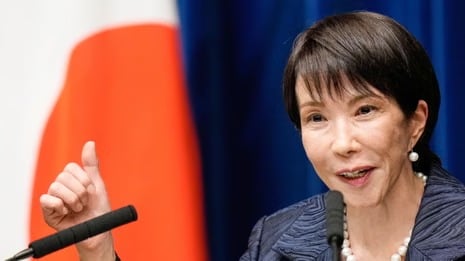
Japan’s Prime Minister Sanae Takaichi is facing a more difficult political period as she approaches the end of her first year in office, with questions emerging about her administration’s economic plans, cabinet discipline and relationships within her own party.
Takaichi made history in October 2025 when she became Japan’s first female prime minister. Her leadership has attracted attention both domestically and internationally, particularly because of her conservative political outlook, direct communication style and approach to relations with major powers.
According to a report published by The Guardian on 21 October 2026, Takaichi has survived early doubts about her political longevity and led her Liberal Democratic Party to a significant electoral victory.
Her public profile has remained strong, with social media providing an important channel through which she communicates policy positions and connects with supporters.
However, the same report describes a growing set of challenges that could affect her ability to maintain political support.
Cabinet controversy creates fresh pressure
One of the immediate difficulties facing the prime minister is a cabinet controversy involving agricultural minister Kazuo Yana.
The Guardian reported that Yana faced criticism over remarks about reducing road funding in municipalities that did not support him. Takaichi initially defended the minister but later described the reported comments as unacceptable if accurately reported.
Yana resigned on 14 October, becoming the first cabinet minister in Takaichi’s government to leave office.
The episode has raised questions about the prime minister’s judgment and how quickly her administration responds when members of the cabinet become embroiled in controversy.
For a prime minister, cabinet discipline is important because individual ministers’ statements can affect public confidence in the government. Delayed responses may also create the impression that political loyalty is being prioritised over accountability.
The incident does not necessarily determine the future of the administration, but it provides an early test of how Takaichi handles pressure from the public, opposition politicians and colleagues within the ruling party.
Economic concerns remain important
The cost of living is another challenge confronting the government.
Takaichi has discussed reducing Japan’s consumption tax on food and drinks from 8% to 1% for two years, alongside cash payments to households facing financial pressure.
Such measures could provide relief to consumers by reducing the tax burden on eligible purchases. However, they would also affect government revenue and require a credible funding plan.
The Guardian reported that Takaichi had insisted the proposal would not require additional borrowing, but questions remained about how the measures would be financed.
Japan already carries a substantial public debt burden relative to the size of its economy. Investors and policymakers therefore pay close attention to proposals that could reduce government income or increase expenditure.
The government’s challenge is to address household financial pressures while maintaining confidence in the country’s public finances.
A clear explanation of the proposed tax changes, their duration and their funding would help businesses and consumers understand what to expect.
Foreign policy and relations with China
Takaichi’s foreign policy has also attracted attention, particularly her approach to relations with China and the United States.
The Guardian reported that her refusal to retreat during a diplomatic dispute with China over Taiwan has won support among some voters. Her relationship with US President Donald Trump has also been a prominent feature of her international engagement.
Japan’s strategic position in East Asia makes relations with both countries important. China is a major trading partner, while the United States remains central to Japan’s security arrangements.
A difficult diplomatic relationship with China could have implications for trade, tourism, investment and regional security. At the same time, close cooperation with Washington can help Japan pursue its defence and economic priorities.
The government must therefore balance domestic political expectations with the practical need to maintain stable international relationships.
Leadership style and party relationships
Takaichi’s personal approach to leadership has attracted both support and criticism.
Her supporters appreciate her direct communication and willingness to articulate policy positions. However, critics have questioned whether her limited informal engagement with colleagues could weaken the relationships needed to manage a complex parliamentary system.
The Guardian reported that she has held fewer dinners with political allies than some predecessors and has relied heavily on her own judgment.
Political alliances matter in Japan because governments depend on cooperation within the ruling party and with coalition partners. Even a popular prime minister can encounter difficulties if colleagues feel excluded from important decisions.
The prime minister must also manage relations with the media, civil servants and business leaders, whose information and advice can influence policy implementation.
Outlook for Japan
Takaichi’s future will depend on whether she can maintain public confidence while addressing economic pressures and managing political controversies.
Her government will need to explain how its proposed cost-of-living measures can be funded, strengthen cabinet accountability and preserve relationships within the ruling coalition.
Foreign policy will remain another important test, particularly as Japan navigates its relationships with China and the United States.
Her first year has demonstrated that she can overcome early doubts and establish a strong public profile. The coming months will test whether that political standing can be converted into sustained policy achievements.