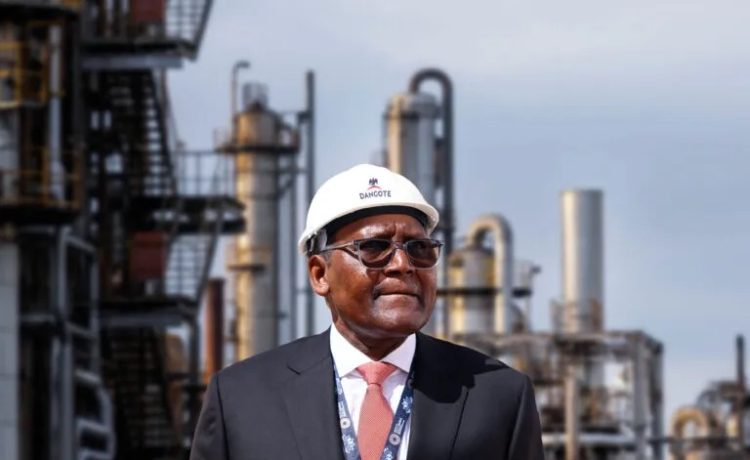
Dangote Petroleum Refinery and Petrochemicals has reported that its initial public offering (IPO) has attracted investor interest from more than 90 countries, including 51 of Africa’s 54 nations.
The development was reported by BusinessDay on October 19, 2026, as the company presented the offering as a major opportunity to broaden participation in one of Africa’s largest industrial projects.
According to the report, the company described the offer as the biggest ever launched on the Nigerian capital market on its opening day. It also said the offering surpassed a previous African record within its first 10 days.
The reported participation includes retail investors, pension funds, institutional investors, asset managers and fintech platforms.
The figures were attributed to the company. They should therefore be understood as reported offering information rather than independently verified evidence that every interested investor has completed a purchase or received shares.
Understanding the IPO
An initial public offering is a process through which a company offers shares to investors under an approved public-offering arrangement.
Depending on the structure of the transaction, an IPO can allow a company to broaden its shareholder base, provide investors with an opportunity to participate in its business and establish a wider public market for its shares.
For companies seeking substantial capital, public offerings can attract a range of investors with different investment objectives and financial resources.
However, the details of an offering matter. Investors need to understand the price, number of shares available, eligibility requirements, application procedures, payment arrangements and relevant deadlines.
They must also establish whether the offer involves newly issued shares, existing shares being sold by current shareholders, or a combination of both.
These distinctions affect how the transaction works and how any proceeds are distributed.
The available BusinessDay report confirms the breadth of investor interest claimed by the company but does not, by itself, establish every detail of the offering’s final financial outcome.
Why the refinery matters to Nigeria
The Dangote refinery is a major industrial investment in Nigeria’s petroleum sector.
Domestic refining capacity is economically important because petroleum products are essential inputs for transportation, manufacturing, agriculture and the distribution of goods.
A large refinery can potentially improve domestic fuel availability and reduce dependence on imported refined products, although the actual effect depends on production volumes, operational performance, pricing, crude supply and distribution arrangements.
Refining also creates connections with other parts of the economy, including shipping, storage, logistics, engineering and industrial services.
For Nigeria, the development of domestic refining capacity has long been linked to efforts to reduce the cost and complexity of importing petroleum products.
Nevertheless, the existence of a refinery does not automatically eliminate fuel-price volatility. International crude prices, exchange rates, operating costs and domestic market conditions continue to influence prices.
Why international investors may be interested
An offering that attracts investors across many countries can increase international awareness of a company’s business and its prospects.
Investors may assess factors such as expected earnings, growth opportunities, industry risks, management, corporate governance and the wider economic environment.
Institutional investors may also evaluate how an investment fits within their portfolios, while individual investors may be interested in the opportunity to own shares in a prominent industrial company.
However, geographical reach does not guarantee investment success. A large number of participating countries does not establish that all investors will earn a profit or that the share price will rise after the offering.
The long-term performance of an investment depends on business results, valuation and market conditions, among other factors.
Implications for Nigeria’s capital market
A large public offering can attract attention to the Nigerian capital market and encourage more people to learn about investing.
It can also test the capacity of financial institutions, brokers, registrars and digital platforms to manage investor applications and related processes.
If investors have positive experiences with transparent and well-regulated offerings, confidence in the market may improve.
However, protecting investors requires clear disclosure, compliance with applicable securities regulations and accessible information about the risks involved.
Potential investors should rely on official offer documents and authorised channels rather than social-media claims or unofficial payment instructions.
Conclusion
The refinery’s reported participation figures highlight the international attention surrounding its IPO and the potential for major industrial offerings to broaden investor participation.
The next important measures will be the final results of the offering, the allocation process, compliance with applicable requirements and the company’s financial performance over time.
For Nigeria’s capital market, the wider significance will depend not only on the size of this particular transaction but also on whether it contributes to sustained investor confidence and more opportunities for responsible capital formation.