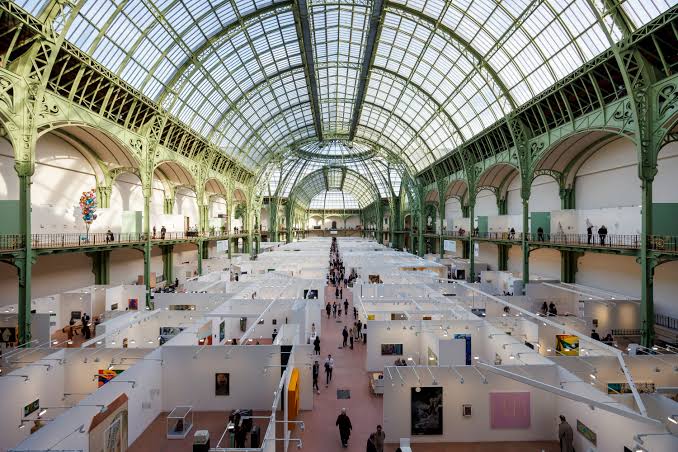
Art Basel Paris will bring together 211 galleries from 41 countries and territories for its fifth edition in October, strengthening the French capital’s position as a major meeting point for the international art market.
Scheduled for October 23 to 25, 2026, at the Grand Palais, the fair will be led for the first time by its new Director, Karim Crippa, and will feature established international galleries alongside emerging dealers and research-led presentations.
Preview Days are scheduled for October 21 and 22, while a public Vernissage will take place on October 22. Art Basel has also scheduled its invitation-only Avant-Première for October 20.
The 2026 edition will include 183 galleries in the main Galeries sector, 16 solo presentations in Emergence and 12 projects in Premise.
Art Basel said 32 galleries will participate in its Paris fair for the first time, while 64 of the participating galleries operate spaces in France. Six galleries are also moving from the Emergence section into the main Galeries sector.
The international representation extends across Europe, Africa, Asia, the Middle East and the Americas, with participating galleries connected to countries including Nigeria, Côte d’Ivoire, South Africa, Tunisia, the United States, China, Japan, South Korea, Brazil, Mexico, Saudi Arabia and the United Arab Emirates.
Record 12 Joint Booths Planned
Collaboration between galleries will be another prominent feature of this year’s fair.
Art Basel Paris will host a record 12 joint booths involving 24 galleries, creating presentations that bring together different gallery programmes and artistic perspectives.
The format allows galleries to combine artists, ideas and curatorial approaches within the same booth rather than operating entirely independently.
It comes as Art Basel Paris seeks to distinguish itself not only through the size of its international exhibitor base but also through experimental presentation formats.
The fair’s Premise sector is also moving into the Salon Seine at the Grand Palais, providing more space and visibility for research-led projects that reconsider established narratives in art history.
Premise is intended to create room for historically focused and unconventional curatorial presentations, while Emergence concentrates on younger galleries and emerging artistic practices.
Together, the three sectors are designed to give visitors exposure to established modern and contemporary artists alongside newer voices and historically oriented projects.
Crippa Takes Charge of Paris Fair
The 2026 edition represents a leadership transition for Art Basel Paris, with Crippa directing the event after previously serving as Director of Communications for the Paris fair.
He took over the leadership role in November 2025.
Crippa has said the fair’s identity is closely connected with Paris itself, including its galleries, museums, artists, collectors and wider creative community.
In an interview published ahead of this year’s edition, he described Art Basel Paris as still a relatively young fair but said its rapid development since launching in 2022 had created an event capable of attracting a broad audience.
That Paris connection is being pushed further in 2026 through a public programme extending beyond the Grand Palais.
Public Programme Expands Across Paris
Major commissions and presentations are planned across several prominent locations in the French capital, including the Petit Palais, Palais d’Iéna, Cité de l’architecture et du patrimoine, Parvis des Droits-de-l’Homme, Beaux-Arts de Paris, Avenue Winston-Churchill, Square Jean Perrin, Place Clemenceau and Jardin de la Nouvelle-France.
The programme effectively expands the fair beyond the traditional exhibition-booth model, linking activities inside the Grand Palais with cultural institutions and public spaces across Paris.
Art Basel’s Conversations programme is also moving into the Grand Palais Auditorium for the first time.
It will bring artists, curators, museum directors, collectors and other cultural figures together for discussions and individual encounters.
The move gives the talks programme a more prominent position within the main fair venue and reflects the organisers’ attempt to combine the commercial art-fair environment with wider conversations about art and cultural institutions.
‘Oh La La!’ Returns With Philippine Leroy-Beaulieu
Another returning feature is Oh La La!, Art Basel Paris’ temporary rehang initiative.
For 2026, French actress Philippine Leroy-Beaulieu will art-direct the programme around the theme “Myths and Legends.”
The two-day initiative gives participating galleries an opportunity to temporarily alter their displays and present works through a common theme, creating a different experience for visitors returning to the fair.
The combination of the expanded public programme, joint booths, new location for Premise and relocation of Conversations forms part of the organisers’ effort to make the fifth edition more closely integrated with Paris’ broader cultural environment.
French Art Market Regains Momentum
The fair is also taking place against a stronger backdrop for the French art market.
According to the Art Basel and UBS Global Art Market Report 2026, sales in France reached approximately $4.5 billion in 2025, representing a 9 per cent year-on-year increase following two consecutive years of contraction.
France accounted for about 8 per cent of the global art market, maintaining its position as the world’s fourth-largest art market and the largest within the European Union.
The presence of 64 participating galleries operating spaces in France consequently gives Art Basel Paris a substantial domestic foundation even as the fair continues to expand its international reach.
The 211-gallery lineup also includes major international names with established Paris operations, alongside galleries coming to the fair from different parts of the world.
For collectors and galleries, the event arrives during a period when the global art market continues to navigate changing buyer behaviour, economic uncertainty and a generational transition among collectors.
Art Basel Paris is increasingly positioning the city itself as part of its response — using the Grand Palais as the commercial centre of the event while extending exhibitions, commissions and conversations into Paris’ wider cultural landscape.
When the doors open in October, its fifth edition will therefore serve as both an international marketplace and a showcase for the continuing role of Paris within the global contemporary art ecosystem.