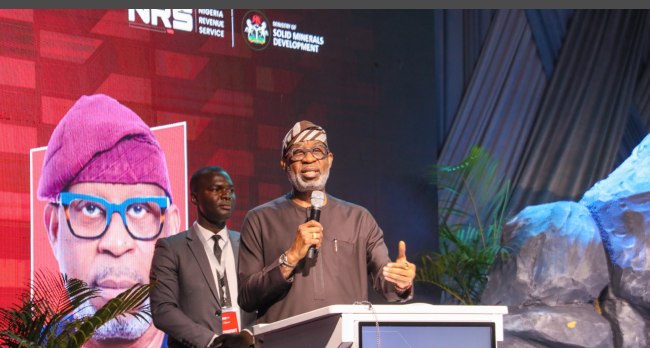
Nigeria’s Minister of Solid Minerals Development, Dele Alake, has said previous political leaders lacked the courage demonstrated by President Bola Tinubu in implementing reforms aimed at rebuilding the Nigerian economy.
Alake made the remarks in Abuja during the 2026 NRS-MSMD Joint Stakeholder Sensitization programme for the North Central region.
The event, themed “From Resource to Revenue: Aligning Solid Minerals Operations with the 2025 Tax Reform Act,” focused on strengthening transparency, compliance, and revenue generation within Nigeria’s solid minerals sector.
According to the Minister, the removal of fuel subsidy by the Tinubu administration in 2023 prevented the Nigerian economy from collapsing under mounting fiscal pressure.
He explained that Nigeria’s economic decline began when the country shifted away from local production in the 1960s, 1970s, and early 1980s toward excessive dependence on imported goods.
Alake said the country gradually adopted a consumption-driven economy that encouraged heavy importation of products that could have been produced locally, resulting in factory closures, rising unemployment, and weakening of the naira.
Reflecting on Nigeria’s economic conditions in the early 1980s, the Minister noted that the naira was once significantly stronger against the U.S. dollar.
“I was privileged to have lived in this country when the naira was strong, and in the early 80s, I bought $1 for 80 kobos,” Alake said. “The official exchange rate then was 52 kobo to one dollar.”
He criticised past administrations for failing to confront the country’s structural economic problems, claiming Nigeria spent hundreds of millions of dollars importing items that could be produced domestically.
According to him, previous governments relied heavily on borrowing to fund recurrent expenditure, including salary payments, rather than investing in productive sectors of the economy.
“When a society or a nation borrows to pay salaries, you know what that means. There can be no development,” he stated.
Alake also alleged that Nigeria resorted to printing over N20 trillion locally after international lenders became increasingly reluctant to extend credit due to deteriorating credit ratings.
The Minister argued that the Tinubu administration’s economic reforms were necessary to halt fiscal mismanagement, block leakages, and reset the economy.
“What would have happened to Nigeria by September 2023 if the president had not removed fuel subsidy?” he asked. “The economy would have crashed completely.”
He likened the administration’s reform agenda to efforts aimed at stopping the country from sinking deeper into economic crisis while laying the foundation for long-term recovery and growth.
Also speaking at the event, Permanent Secretary of the Ministry of Solid Minerals Development, Faruk Yusuf Yabo, stressed the need to reposition Nigeria’s solid minerals sector to support economic diversification, job creation, and sustainable development.
According to him, stronger compliance, transparency, and collaboration with the Nigeria Revenue Service are essential to improving sector revenue generation and reducing leakages.
Yabo added that aligning mining operations with the 2025 Tax Reform Act would help Nigeria derive greater value from its mineral resources while strengthening the royalty administration framework.