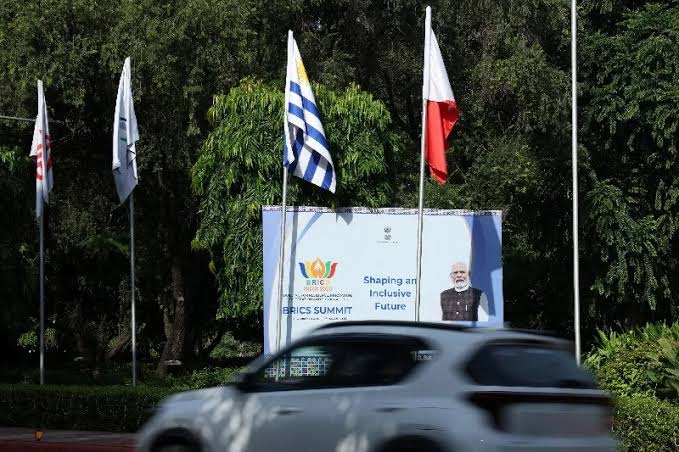
Africa’s members of the expanded BRICS grouping are preparing for a critical leaders’ summit in New Delhi as the continuing Iran conflict exposes deep divisions inside one of the world’s most influential emerging-market blocs.
The summit, scheduled for September 12 and 13, will bring together leaders from an expanded BRICS that now includes South Africa, Egypt and Ethiopia alongside Brazil, Russia, India, China, Iran, the United Arab Emirates and Indonesia.
South African President Cyril Ramaphosa and Egyptian President Abdel Fattah el-Sisi are among the leaders expected to attend.
The meeting comes at a difficult moment for the bloc.
The war involving Iran has created tensions among BRICS members, particularly between Tehran and Abu Dhabi, potentially complicating attempts to reach consensus on a joint declaration.
Africa’s BRICS Presence Has Expanded
For years, South Africa was the organisation’s only African member.
That changed with the expansion of BRICS, which brought Egypt and Ethiopia into the grouping alongside several other emerging economies.
Their inclusion has strengthened Africa’s representation within a forum that increasingly presents itself as a voice for the Global South.
For African governments, BRICS provides another platform through which to pursue investment, development finance, trade and reform of international institutions.
But expansion has also made consensus more difficult.
The original BRICS countries already had different economic and geopolitical priorities. Adding new members has broadened those differences further.
Iran Conflict Puts Consensus to Test
Those tensions are now particularly visible over Iran.
Reuters reported that BRICS foreign ministers failed to produce a joint statement at a meeting in New Delhi in May because of disagreements involving Iran and the UAE.
The leaders’ summit will therefore test whether the organisation can find language acceptable to members positioned differently on the conflict.
For African members, the issue is far from remote.
The disruption of global oil flows has pushed crude prices above $100 per barrel, affecting fuel-importing African economies and increasing transportation and production costs.
At the same time, oil-producing African countries could benefit from stronger demand for alternative crude supplies.
Chinese refiners are already increasing purchases from producers including Angola and the Republic of Congo as they search for alternatives to disrupted Middle Eastern supplies.
Bigger Question for the Global South
The New Delhi summit will consequently be about more than the immediate conflict.
BRICS has expanded partly because emerging economies want greater influence over institutions traditionally dominated by Western powers.
But an organisation built around consensus must demonstrate that a larger membership does not make collective action impossible.
For South Africa, Egypt and Ethiopia, the summit provides an opportunity to ensure African priorities remain visible within that debate.
Development financing, trade, energy security and reform of the global financial architecture remain particularly important to African economies.
The outcome in New Delhi will therefore help determine whether the expanded BRICS can translate its growing size into greater influence — or whether geopolitical divisions among its members begin limiting its effectiveness.