
Global financial markets experienced a significant shift in investor sentiment as the outcome of the US midterm elections triggered a broad rotation across Asian equities.
Investors moved away from high-growth technology stocks, particularly semiconductor companies, while increasing exposure to previously underperforming markets, including China and Australia.
The changing market direction reflected concerns that a Democratic sweep of the US Congress could lead to tighter regulatory oversight of certain industries, particularly artificial intelligence infrastructure and data centres.
South Korea’s stock market was among the biggest casualties of the shift, with major semiconductor companies recording substantial losses.
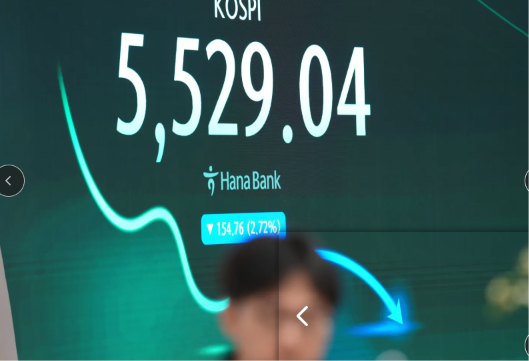
The Kospi Index, which has benefited from strong investor interest in artificial intelligence and semiconductor-related stocks, declined by 5.5 per cent.
The decline highlighted how quickly investor sentiment can change when political developments create uncertainty around the future regulatory environment for major industries.
South Korean Semiconductor Stocks Lead Market Declines
South Korea’s technology sector experienced heavy selling pressure as investors reassessed the outlook for artificial intelligence-related investments.
Samsung Electronics and SK Hynix, two of the world’s leading memory chip manufacturers, both declined by more than 7 per cent in the reported market session.
The losses reflected concerns that increased regulatory oversight in the United States could affect the expansion of data centres and the massive investments required to support artificial intelligence infrastructure.
The Kospi’s sharp decline demonstrated the vulnerability of markets that have benefited significantly from the global AI investment boom.
South Korean semiconductor companies have attracted substantial investor interest because of their role in supplying advanced memory chips used in AI servers and data centres.
However, uncertainty over future US technology policies has encouraged investors to reduce exposure to the sector.
The weakness was not limited to South Korea. Other Asian technology markets, including Japan and Taiwan, also experienced pressure as investors reconsidered the outlook for semiconductor companies.
Chinese Technology Stocks Rally as Investors Rotate Funds
While South Korean chipmakers suffered significant losses, Chinese technology companies attracted renewed buying interest.
Tencent Holdings and Alibaba Group both gained at least 6 per cent, helping lift Hong Kong’s Hang Seng Tech Index by 5.1 per cent in the reported session.
The gains reflected a shift in investor positioning towards markets and companies that had previously underperformed.
Chinese technology and consumer-facing businesses appeared to benefit from the rotation as investors searched for opportunities outside the heavily valued semiconductor sector.
The rally also highlighted the changing dynamics of global technology investment, with investors becoming more selective about which companies and markets could benefit from the next phase of technological development.
Beyond technology, markets in Australia and parts of Southeast Asia also attracted investor interest as funds moved towards sectors considered less exposed to the immediate risks surrounding AI infrastructure spending.
The development suggests that investors are increasingly differentiating between technology hardware companies and other businesses that could benefit from changing global economic conditions.
Oil Prices Extend Losses on Middle East Peace Hopes
Oil markets remained under pressure following a sharp decline in crude prices on Wednesday.
Brent crude extended its losses after falling more than 8 per cent in the previous trading session.
The decline followed the Democratic Party’s strong performance in the US midterm elections, which raised expectations that the new political balance in Congress could increase pressure on the Trump administration to pursue efforts to end the Middle East conflict.
Investors interpreted the possibility of reduced geopolitical tensions as a potential easing of supply-related risks that had supported oil prices.
Lower crude prices could also reduce energy costs for businesses and consumers, particularly in economies that depend heavily on imported petroleum products.
However, developments in the Middle East remain important to the oil market because any escalation could quickly reverse the recent decline.
The movement in crude prices also affected energy-related stocks, as investors adjusted their expectations for oil revenues and the profitability of companies operating in the sector.
Treasury Bonds Gain as Dollar Weakens
The decline in oil prices provided support for government bonds, with US Treasuries advancing for a second consecutive day.
Investors increased their interest in fixed-income securities amid expectations that lower energy prices could help moderate inflation.
Since energy costs influence transportation, manufacturing and several other economic activities, sustained reductions in crude prices could ease broader inflationary pressures.
This could provide central banks with greater flexibility when considering future monetary policy decisions.
The US dollar also weakened against all its Group-of-10 currency peers, reflecting changing investor expectations following the election results.
The weaker dollar provided additional support for other currencies and could improve the appeal of dollar-priced commodities to buyers using different currencies.
The combination of falling oil prices, stronger bond demand and a weaker dollar illustrated how political developments in the United States were influencing financial markets across different asset classes.
US Midterm Elections Reshape Global Investment Sentiment
The Democratic Party’s strong performance in the midterm elections has become a major consideration for investors assessing the direction of US economic and regulatory policies.
The results have raised expectations of increased congressional scrutiny of major technology investments, particularly the rapid expansion of data centres and artificial intelligence infrastructure.
Investors are also considering the possibility of changes to energy, trade and foreign policy priorities.
Although the election outcome does not automatically translate into immediate regulatory changes, the prospect of a different policy environment has been enough to trigger significant adjustments in investment positions.
For Asian markets, the impact has been particularly visible because of the region’s important role in global semiconductor manufacturing.
South Korea and Taiwan are major suppliers of advanced chips and related components, making their stock markets sensitive to changes in expectations surrounding global technology spending.
Meanwhile, China’s technology and consumer sectors have attracted fresh attention as investors look beyond the companies that have dominated the AI investment trade.
Market Outlook: Investors Watch Policy Changes and Oil Prices
The latest market movements demonstrate how political developments can influence investment decisions across international financial markets.
For semiconductor companies, the immediate concern is whether increased regulatory scrutiny could slow data-centre construction and affect the pace of AI-related spending.
For China, renewed investor interest could provide support for technology and consumer stocks that have struggled to match the performance of their global competitors.
Oil markets will also remain sensitive to developments in the Middle East, particularly any diplomatic efforts that could reduce geopolitical risks.
Meanwhile, bond investors will continue monitoring inflation expectations and the implications of lower energy prices for US monetary policy.
The overall outlook remains uncertain, as investors balance the potential benefits of lower oil prices against concerns about technology regulation and the future direction of global economic policies.
For now, the post-election rotation has created clear winners and losers across Asian markets, with Chinese technology stocks gaining while South Korean semiconductor giants face renewed selling pressure.
Global Markets at a Glance
| Market/Asset | Reported movement |
|---|---|
| South Korea’s Kospi | -5.5% |
| Samsung Electronics | More than -7% |
| SK Hynix | More than -7% |
| Hang Seng Tech Index | +5.1% |
| Tencent Holdings | At least +6% |
| Alibaba Group | At least +6% |
| Brent crude | Extended losses |
| US Treasuries | Advanced for second day |
| US dollar | Weakened against G10 peers |
Market figures reflect the reported trading snapshot and may differ across exchanges and publication times.