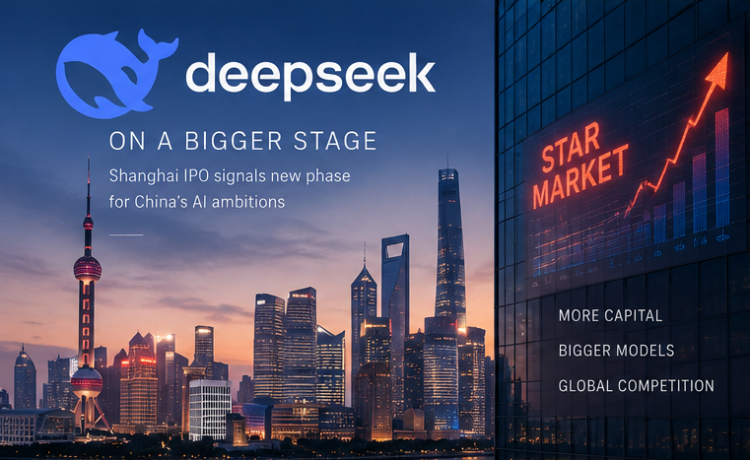
Chinese artificial intelligence startup DeepSeek has taken another step towards a domestic stock-market listing after appointing CITIC Securities to prepare the company for an initial public offering on Shanghai’s technology-focused STAR Market.
Two people familiar with the matter said DeepSeek intends to begin the IPO process before the end of 2026, although the final timing, fundraising target and listing valuation have not yet been determined.
DeepSeek and CITIC Securities had not publicly commented on the discussions at the time of reporting.
The appointment of an investment bank for pre-listing preparations indicates that the company is advancing beyond preliminary consideration of an IPO.
DeepSeek Needs Capital for AI Expansion
The Hangzhou-based company is seeking additional capital to finance computing infrastructure, model development and recruitment as competition intensifies between Chinese and American AI companies.
Training and operating increasingly sophisticated AI systems requires enormous investment in semiconductor hardware, electricity, data centres and specialist engineers.
That has pushed many AI companies towards outside investors and public markets.
DeepSeek was valued at about 500 billion yuan, or roughly $75 billion, following a June funding round in which it raised approximately $7.4 billion, according to Reuters.
Founder Liang Wenfeng reportedly contributed 20 billion yuan to the financing, while Tencent and CATL were among other investors.
China Builds Domestic AI Champions
The prospective IPO would also fit Beijing’s broader effort to develop a domestic technology ecosystem capable of competing with the United States.
China has invested heavily in local semiconductor manufacturing, artificial intelligence and cloud infrastructure as US export restrictions have limited access to some of the world’s most advanced chips.
Domestic capital markets are increasingly becoming an important source of financing for AI developers attempting to scale despite those constraints.
Other Chinese AI companies have also moved towards public listings.
Z.ai and MiniMax have listed in Hong Kong, while Moonshot AI has reportedly filed confidentially for its own offering.
Talent Battle Adds Pressure
Capital is not the only challenge.
Chinese AI companies are also engaged in an intense battle for engineers and researchers, with technology groups including ByteDance and Xiaomi competing aggressively for specialist talent.
For DeepSeek, access to public-market funding could provide greater resources for compensation, infrastructure and research.
An IPO could also give employees equity that can be traded publicly, potentially making it easier to retain valuable technical staff.
The broader significance lies in how quickly the AI sector is becoming capital-intensive.
The competition is no longer simply about building impressive models. Companies now need sufficient financial resources to fund chips, data centres, salaries and model development over multiple generations.
A successful STAR Market listing would therefore give DeepSeek additional financial firepower as it attempts to remain one of China’s leading competitors in the global AI race.