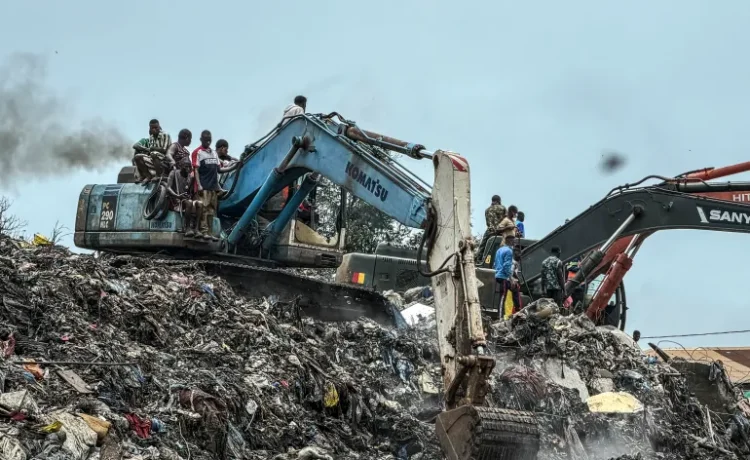
At least 30 people have died after a massive mound of rubbish collapsed at a major landfill in Guinea’s capital, Conakry, burying nearby homes and triggering a large-scale search and rescue operation.
The disaster occurred at the Dar-es-Salam landfill following heavy rainfall.
Rescue workers have been using excavators and other equipment to search through the debris for survivors and victims.
The tragedy has raised fresh concerns about urban planning, waste management and the risks faced by communities living close to major landfill sites.
A disaster after heavy rainfall
Heavy rainfall played a major role in the collapse.
Large waste mounds can become unstable when saturated with water.
The weight of accumulated rubbish can create dangerous pressure, particularly when waste is deposited without adequate engineering controls.
The collapse buried tents, shacks and other structures near the landfill.
Several people were also injured.
Evacuation concerns
The disaster is particularly troubling because authorities had reportedly issued warnings and evacuation orders to residents living close to the landfill before the collapse.
The warnings reflected concerns about the stability of the site.
Despite those concerns, people continued to live and operate businesses in the surrounding area.
The tragedy has therefore raised questions about whether adequate enforcement and relocation measures were implemented.
Waste management challenge
Conakry, like many rapidly growing African cities, faces significant waste management challenges.
Population growth increases the amount of waste produced.
Urban expansion also pushes residential communities closer to waste disposal sites.
When waste infrastructure fails to keep pace with population growth, environmental and public-health risks increase.
Landfills require careful engineering.
Waste must be compacted and managed.
Water drainage systems must be maintained.
Communities should also be protected from unstable waste slopes.
Poverty and informal settlements
One of the broader issues is the relationship between poverty and environmental risk.
People living near landfills may do so because housing elsewhere is unaffordable.
Informal settlements can expand rapidly around urban infrastructure.
Residents may also depend on waste-related economic activities for their livelihoods.
This makes relocation difficult.
Simply ordering people to leave does not necessarily solve the problem.
Authorities must provide safer alternatives.
Climate risks
Heavy rainfall is becoming an increasingly important consideration in urban planning.
Cities need infrastructure capable of handling extreme weather.
Drainage systems, roads, waste facilities and residential developments all need to account for flooding and landslide risks.
For cities such as Conakry, climate resilience is therefore becoming part of the broader development agenda.
Human cost
The most immediate concern is the families affected by the disaster.
People have lost relatives, homes and possessions.
Rescue workers are also operating under dangerous conditions as they search through unstable debris.
The final death toll could change as rescue operations continue.
What the disaster means for Guinea
The collapse could force the government to reassess waste management policies in Conakry.
Authorities may need to inspect other landfill sites.
They may also need to identify communities facing similar risks.
Improving waste management will require significant investment.
However, the cost of inaction can be much greater.
The Conakry disaster demonstrates that waste management is not simply an environmental issue.
It is a public safety issue.
As African cities grow, governments will need to invest in modern waste infrastructure capable of handling increasing populations and changing climate conditions.
For Guinea, the immediate priority remains rescue and support for affected families.
The longer-term challenge will be ensuring that a tragedy of this scale is not repeated.