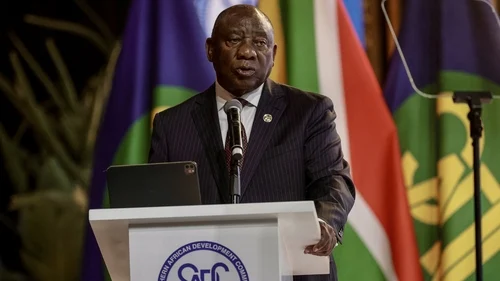
South African President Cyril Ramaphosa has called for greater regional cooperation to address migration as tensions surrounding foreign nationals continue to grow in parts of the country.
The issue has become one of the most sensitive social and political challenges facing South Africa.
For years, South Africa has attracted migrants from across the African continent because of its relatively large economy and employment opportunities.
However, high unemployment, poverty and pressure on public services have contributed to growing frustration in some communities.
Foreign nationals have increasingly found themselves at the centre of political debates over jobs, housing, healthcare and other public services.
Migration becomes a regional issue
Ramaphosa has argued that migration cannot be addressed by South Africa alone.
Many migrants entering South Africa come from neighbouring and other African countries.
Their movement is influenced by economic conditions, employment opportunities, political instability and differences in living standards.
A regional response could therefore address some of the underlying factors that encourage people to leave their home countries.
This could include stronger economic cooperation, improved border management and greater investment in employment opportunities.
Unemployment fuels tensions
One of the biggest challenges facing South Africa is unemployment.
Large numbers of young people struggle to find jobs, creating frustration among communities already facing economic hardship.
Some political groups and community organisations have accused foreign nationals of taking jobs from South Africans.
However, migration is only one factor affecting employment.
South Africa’s economic challenges are linked to several deeper issues, including slow economic growth, skills shortages, inequality and structural weaknesses in the labour market.
The debate over migration can therefore become complicated when broader economic problems are blamed primarily on foreigners.
Anti-migrant sentiment grows
Anti-migrant sentiment has become increasingly visible in South Africa.
Some groups have organised protests and campaigns calling for stronger immigration enforcement.
In extreme cases, foreign nationals have faced threats, harassment and violence.
These incidents have created concern among human rights organisations and neighbouring governments.
South African authorities face the difficult responsibility of enforcing immigration laws while protecting all people within the country’s borders.
The government has repeatedly stressed that immigration enforcement must be conducted through legal channels.
Regional cooperation could offer solutions
A coordinated regional approach could help address some of the problems associated with migration.
Countries could cooperate on border management and information sharing.
They could also improve systems for legal migration, making it easier for workers to move between countries through recognised channels.
Regional governments could further collaborate on economic development.
Creating more jobs and business opportunities in countries experiencing high levels of outward migration could reduce the economic pressure that encourages people to leave.
Such measures would require significant investment.
Infrastructure, education, healthcare and private-sector development all play a role in creating sustainable employment.
South Africa’s position
South Africa remains one of the continent’s most important economic centres.
Its financial system, industrial sector and relatively developed infrastructure make it attractive to migrants.
The country also has strong historical and cultural connections with neighbouring states.
Millions of people across Southern Africa have family, business and social connections that cross national borders.
This makes migration difficult to treat simply as a security issue.
It is also a social and economic issue.
Human rights concerns
Human rights organisations have warned that migration enforcement must not lead to discrimination.
Foreign nationals remain entitled to basic legal protections.
Authorities must distinguish between legitimate immigration enforcement and attacks motivated by xenophobia.
Protecting migrants is also important for South Africa’s international reputation.
The country has historically promoted African integration and cooperation.
Widespread anti-migrant violence could damage relationships with neighbouring countries and create diplomatic tensions.
Pressure on government
The migration debate also presents a political challenge for the South African government.
Citizens want the government to address unemployment, crime, housing shortages and pressure on public services.
At the same time, regional partners expect South Africa to treat migrants fairly.
Balancing these competing demands will require careful policymaking.
The government must demonstrate that it can manage immigration effectively without allowing migrants to become scapegoats for broader economic problems.
Looking beyond borders
Ramaphosa’s call for regional cooperation reflects the reality that migration is not confined to one country.
People move because of economic opportunities, family connections, security concerns and personal aspirations.
Trying to manage these movements solely through border controls is unlikely to solve the underlying problem.
Regional economic development could provide a more sustainable solution.
If young people can find good jobs and build businesses in their home countries, fewer may feel compelled to migrate because of economic desperation.
For South Africa, the challenge will be to combine effective immigration management with policies that support economic growth and social stability.
The migration debate is likely to remain important across Southern Africa.
How governments respond could shape regional relations and influence attitudes towards African integration for years to come.