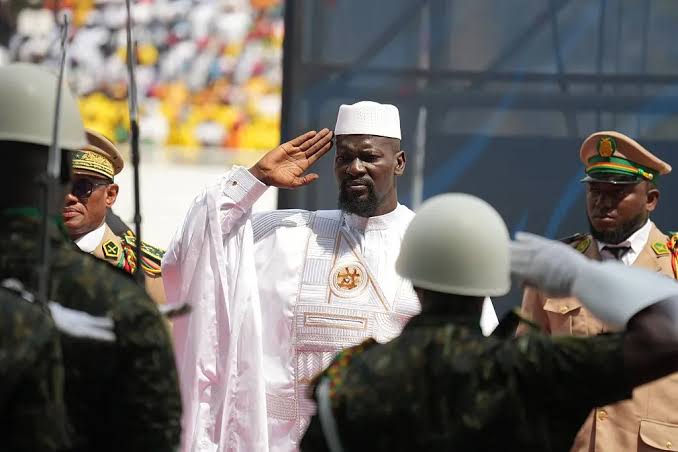
The government of Guinea has dissolved 40 political parties, including the country’s three main opposition groups, in a move critics say could pave the way for a one-party state under President Mamady Doumbouya.
The decree, issued late Friday by the Guinea Ministry of Territorial Administration and Decentralisation, cited the parties’ failure to comply with legal and administrative requirements.
Beyond revoking their legal status, the order also froze the parties’ assets and banned the use of their names, logos, and emblems. A government-appointed curator has been tasked with supervising the transfer of their holdings.
Among the most prominent parties affected are the Union of Democratic Forces of Guinea, the Rally of the Guinean People—the party of former president Alpha Condé—and the Union of Republican Forces.
The three opposition parties had already been suspended in August last year, weeks before a constitutional referendum that cleared the way for Doumbouya to contest the December presidential election.
Reacting to the decision, the leader of the Union of Democratic Forces of Guinea, Cellou Dalein Diallo, accused the government of dismantling democratic institutions to tighten its grip on power.
Speaking from exile in a video posted on social media, Diallo described the dissolution as part of a deliberate effort to establish a “party-state” and urged supporters to unite against the government.
He argued that political dialogue and legal avenues had been exhausted, while a communications coordinator of his party described the decree as “the final act of a true political farce.”
Meanwhile, pro-democracy activist Ibrahima Diallo of the National Front for the Defence of the Constitution warned that the decision had effectively “formalised a dictatorship,” adding that the country now faces deep political uncertainty.
The latest move is seen as part of a broader crackdown on dissent under Doumbouya, who seized power in a 2021 military coup before later winning a presidential election in December in which major opposition figures were barred from participating.
Since assuming power, the government has shut down media outlets, banned protests, and arrested or forced several opposition politicians and civil society activists into exile.
Human rights groups have also raised concerns over the disappearance of pro-democracy activists and the alleged abduction of relatives of prominent dissidents.
The political developments in Guinea come amid a broader trend of military takeovers across parts of Africa. Since 2020, a series of coups has brought military leaders to power in countries stretching across the Sahel region, a development analysts have described as a growing “coup belt.”
Although some of the coups have initially received public support, observers warn that many of the new regimes have increasingly restricted civil liberties and political freedoms.
Studies on global governance trends also indicate that while the overall rate of military coups worldwide has declined, the risk of such takeovers remains relatively high in parts of Africa.