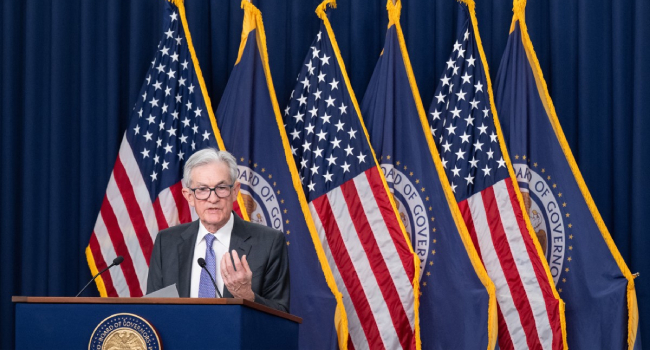
Outgoing Chair of the Federal Reserve, Jerome Powell, has announced plans to remain on the Board of Governors after his tenure as chair ends on May 15, signaling continuity at the central bank during a period of political and legal uncertainty.
Speaking at his final press conference in the role, Powell said he would continue serving as a governor for an unspecified period, potentially until 2028, while maintaining a low profile.
“After my term as chair ends on May 15, I will continue to serve as a governor for a period of time to be determined,” Powell stated, noting that his decision is tied to concerns over legal challenges facing the institution rather than political criticism.
His remarks come amid heightened tensions with Donald Trump, who has repeatedly criticised the Fed for not cutting interest rates more aggressively. While lower rates could stimulate economic activity, policymakers warn they may also fuel inflation.
The situation has been further complicated by legal developments involving the central bank. The administration previously attempted to remove Fed governor Lisa Cook over allegations now before the Supreme Court, while the Justice Department had opened a criminal probe into Powell related to cost overruns on a renovation project.
Although that investigation has since been dropped, Powell said he intends to remain at the Fed until the matter is fully resolved, emphasising the importance of an independent central bank “free of political influence.”
Meanwhile, Powell congratulated Kevin Warsh, his expected successor, after the Senate Banking Committee advanced his nomination in a closely contested vote.
The leadership transition comes at a delicate moment for US monetary policy. The Fed opted to keep interest rates unchanged for a third consecutive meeting, maintaining the benchmark range between 3.50 per cent and 3.75 per cent amid rising uncertainty linked to the US-Israel war on Iran.
The decision exposed deep divisions within the central bank, with four of 12 voting members opposing the outcome — the highest level of dissent since 1992. Governor Stephen Miran pushed for a rate cut, while Fed presidents Beth Hammack, Neel Kashkari, and Lorie Logan supported holding rates steady but disagreed with forward guidance suggesting possible cuts.
The central bank noted that inflation remains elevated, partly due to rising global energy prices driven by geopolitical tensions. While the Fed has been easing rates since late 2025, analysts warn that persistent inflationary pressures could force policymakers to reconsider their stance.
Powell expressed confidence in Warsh’s ability to lead the institution through this transition, particularly in building consensus among policymakers.
However, the nomination process has drawn criticism from Democrats, including Elizabeth Warren and Raphael Warnock, who raised concerns about political interference in the Fed. Republican Senator Thom Tillis ultimately backed Warsh after the Justice Department dropped its probe.
As the Federal Reserve prepares for a leadership change, Powell’s decision to remain on the Board underscores ongoing concerns about institutional independence and the evolving challenges facing US monetary policy.