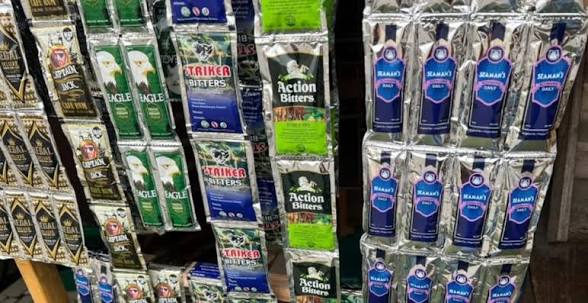
The Federal Government on Tuesday formally flagged off a nationwide enforcement and public enlightenment campaign on the ban of alcoholic beverages packaged in sachets and small PET and glass bottles below 200 millilitres.
The joint press conference, held in Abuja, was organised by the National Orientation Agency in collaboration with the National Agency for Food and Drug Administration and Control and the Federal Competition and Consumer Protection Commission.
The ban, which took effect on January 1, 2026, targets the production, distribution, and sale of alcohol in sachets and bottles smaller than 200ml. The measure is aimed at curbing underage drinking and harmful consumption patterns.
Speaking at the briefing, NAFDAC Director-General, Prof. Mojisola Adeyeye, said the enforcement followed years of consultations, extensions, and alarming survey findings on alcohol consumption among minors.
“We are here to ensure that the ban on sachet alcohol and alcohol in small bottles less than 200ml is enforced across all age groups in Nigeria.
“The availability and easy access to alcohol have been identified as contributory factors to the increasing alcohol consumption among minors,” she said.
Adeyeye explained that discussions around regulating high-concentration alcohol in sachets began in 2018, when industry groups raised concerns about the impact on their businesses.
She said the Association of Food, Beverage and Tobacco Employees and the Distillers and Blenders Association of Nigeria had approached NAFDAC through the Ministry of Health over moves to reduce alcohol concentration in sachets, which at the time was about 50 per cent, compared to beer’s six to eight per cent.
According to her, the then Minister of Health, Prof. Isaac Adewole, granted a five-year moratorium to allow the companies restructure their operations. The moratorium elapsed in February 2024, prompting NAFDAC to begin enforcement in line with its statutory mandate.
She added that resistance from stakeholders led to further delays, including intervention by the National Assembly and an additional one-year extension granted in December 2024 by the current Minister of Health, Prof. Muhammad Pate. The Senate later directed the agency to resume strict enforcement.
Adeyeye said findings from national surveys on underage drinking were “damning.”
“It was found that 54.3 per cent of minors and underage individuals obtain alcohol by themselves from various sources. About 49.9 per cent patronise retailers selling drinks in sachets and PET bottles. Approximately 50 per cent of our children drink alcohol,” she said.
She noted that nearly half of minors who procure alcohol themselves choose sachets because they are easy to conceal.
The NAFDAC boss also revealed that children as young as nine years old were found to consume alcohol, with binge drinking reported in some states.
Highlighting health risks, she warned that alcohol could damage the hippocampus and prefrontal cortex of young people, leading to long-term issues with learning, memory, and impulse control.
“Youth who begin drinking before age 15 are 41 per cent more likely to become dependent on alcohol. The study also shows they may graduate to using cocaine and other narcotics,” she said.
Adeyeye linked alcohol abuse to broader social challenges, including crime and drug dependency, stressing that limiting access to small, easily concealed packs would help reduce underage drinking.
In his remarks, Director-General of NOA, Lanre Issa-Onilu, described the campaign as a united effort to safeguard Nigerians.
“Today, we are taking a united stand for the health, safety, and protection of Nigerian consumers. For too long, sachet alcohol has been dangerously accessible.
“It is inexpensive, portable, and easy to conceal. When affordability meets vulnerability, the consequences are profound,” he said.
Issa-Onilu said the agency would deploy its 818 offices across the 774 local government areas to drive awareness and ensure compliance.
He urged parents, community leaders, retailers, and distributors to support the policy and enforcement efforts.
“Consumer protection is public protection. Market responsibility is national responsibility. No nation prospers when its youth are caught in cycles of preventable addiction,” he said.