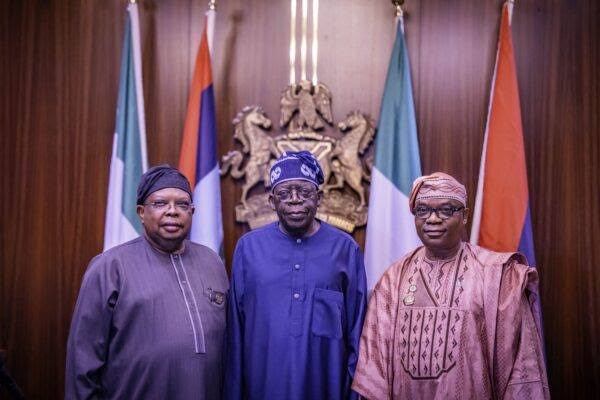
President Bola Tinubu on Monday swore in Mr Joseph Tegbe as the new Minister of Power and Ambassador Sola Enikanolaiye as Minister of State for Foreign Affairs.
The inauguration ceremony took place at the Council Chamber of the Presidential Villa in Abuja and was attended by the ministers’ spouses, senior government officials and members of the Federal Executive Council.
According to a statement issued by the President’s Special Adviser on Information and Strategy, Bayo Onanuga, the appointments followed the resignation of former Power Minister Adebayo Adelabu and former Foreign Affairs Minister Yusuf Tuggar.
Both former ministers stepped down from office ahead of the All Progressives Congress primary elections scheduled for May 2026.
President Tinubu nominated Tegbe and Enikanolaiye on May 5, 2026, while the Senate confirmed their appointments on May 6.
Their inauguration marks another phase in the ongoing restructuring of the Federal Executive Council.
The appointments come after the Secretary to the Government of the Federation directed ministers with political ambitions to resign before participating in party primaries.
The directive was issued in March 2026.
The new ministers are the second set of appointments made under the arrangement, following the swearing-in of Dr. Muttaqha Darma as Minister of Housing and Urban Development on April 30, 2026.
Darma replaced Dr. Ahmed Dangiwa as part of a broader cabinet reorganisation.
Ambassador Enikanolaiye fills the position of Minister of State for Foreign Affairs following the elevation of Bianca Odumegwu-Ojukwu to the substantive Minister of Foreign Affairs role after Tuggar’s resignation.
A seasoned diplomat, Enikanolaiye hails from Igbagun in Kogi State and has spent more than three decades in Nigeria’s foreign service.
He earned a First Class degree in Political Science from Ahmadu Bello University, Zaria, where he graduated as the best student in his faculty.
He later obtained a Master’s degree in International Law and Diplomacy from the University of Lagos with distinction.
Enikanolaiye joined the Ministry of Foreign Affairs in 1982 and rose through the ranks to become Permanent Secretary of the ministry in 2016.
During his diplomatic career, he served in several countries, including Ethiopia, Serbia, Canada, the United Kingdom and India.
His final foreign posting was as Nigeria’s High Commissioner to India.
Before his ministerial appointment, he served as Senior Special Assistant to the President on Foreign Affairs and International Relations.
He has received several national honours and professional recognitions, including the Presidential Civil Service Merit Award and the Presidential Distinguished Public Service Career Award.
Meanwhile, the new Minister of Power, Joseph Tegbe, brings more than 35 years of experience in both the public and private sectors.
Born in Ibadan, Oyo State, Tegbe holds a First Class degree in Civil Engineering from Obafemi Awolowo University.
He also earned a Master of Business Administration from Switzerland and a Master of Public Administration from the University of Birmingham in the United Kingdom.
Tegbe previously served as Senior Partner and Head of Advisory Services at KPMG Africa, where he played key roles in policy reforms and public sector transformation initiatives.
His professional experience spans multiple sectors, including telecommunications, energy, taxation and infrastructure.
He has worked with organisations such as the Nigerian Communications Commission, Nigerian Bulk Electricity Trading Plc, the Nigerian Electricity Regulatory Commission, Shell, Huawei, General Electric and MTN.
Prior to his appointment, he served as Director-General and Global Liaison of the Nigeria-China Strategic Partnership.
His appointment comes at a critical time for Nigeria’s power sector, which continues to face challenges related to electricity generation, transmission and distribution.
President Tinubu initially constituted his cabinet on August 21, 2023, when he inaugurated 45 ministers at the State House Conference Centre in Abuja.
The administration carried out its first major cabinet reshuffle in October 2024 and has since implemented a series of changes involving appointments, replacements and portfolio adjustments.
With the latest additions, the Tinubu administration has now recorded at least 12 cabinet changes since assuming office in 2023, reflecting ongoing efforts to reposition key ministries and align the government’s leadership structure with evolving policy priorities.