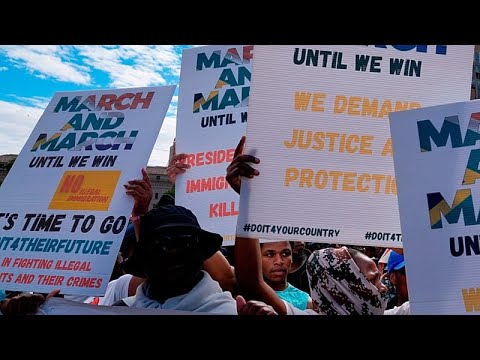
Hundreds of anti-migrant protesters marched through a township outside Johannesburg on Monday, intensifying pressure on the South African government to address illegal immigration.
The demonstration came a day after President Cyril Ramaphosa pledged action against groups accused of fuelling xenophobic violence and taking the law into their own hands.
South Africa has experienced recurring outbreaks of anti-migrant violence over the years, with tensions rising again in 2026 after vigilante groups reportedly ordered undocumented foreigners to leave the country by June 30.
Protesters marched through Kwa-Thema, a township located about 40 kilometres southeast of Johannesburg, chanting and singing while demanding stricter border controls and stronger enforcement of immigration laws.
Leading campaigner Nkosikhona Phakel’umthakathi Ndabandaba said protesters wanted the government to take decisive action.
“We want the government to implement the laws and go and build a wall on the border. Stop these people from flocking into the country. That is simple,” he said.
The march remained peaceful, although some participants carried sticks while others displayed placards bearing messages such as “Go Home.”
Similar demonstrations were reported in other parts of the country, including the Western Cape and Limpopo provinces, suggesting that the anti-immigration movement is gaining momentum.
The latest wave of unrest has already claimed lives.
Reports indicate that at least two Mozambican nationals have been killed, while several African countries have begun arranging the return of citizens who fear for their safety.
In a national address on Sunday evening, Ramaphosa acknowledged public concerns about illegal immigration but stressed that no individual or group has the authority to enforce the law independently.
“We will and must not allow groups to use the legitimate concerns of South Africans to destabilise our country through inciting lawlessness and violence,” the president said.
He warned against profiling individuals based on appearance or nationality.
“No one is allowed, for example, to confront someone in the street to demand proof of nationality,” Ramaphosa stated.
The president also reaffirmed South Africa’s commitment to equality and human rights.
“There is no space for xenophobia, racism, sexism, Afrophobia or any other forms of intolerance in South Africa,” he said.
Ramaphosa vowed that authorities would take action against individuals and groups seeking to exploit immigration concerns for political, personal or criminal gain.
Despite the warning, protest organisers said they would continue their campaign.
Ndabandaba welcomed the president’s recognition of the immigration issue but urged the government to address what protesters describe as the root causes of public frustration.
“We respect him as a leader and we hope he will deliver another speech that is directed to the problems that we have,” he said.
South Africa is home to more than three million foreign nationals, representing just over five per cent of the country’s population.
The nation also faces a high unemployment rate exceeding 30 per cent, a factor analysts say has contributed to growing tensions between local communities and migrant workers.
The country has experienced several major outbreaks of xenophobic violence in recent decades.
In 2008, at least 62 people were killed during one of the deadliest episodes of anti-immigrant violence in South Africa’s history.
Further violent incidents occurred in 2015, 2016 and 2019.
Last month, hundreds of foreign nationals from countries including the Democratic Republic of Congo, Rwanda and Somalia sought refuge in Durban after reporting threats and intimidation from local residents.
South Africa’s Ministry of Police condemned the attacks in a statement issued on April 24.
The ministry described the violence and intimidation directed at Ghanaian nationals and other foreign citizens as unlawful and contrary to the country’s democratic values.
“These actions are not only unlawful but they stand in direct opposition to the values of dignity, equality and human rights upon which our democracy is founded,” the statement said.
The government also reiterated that South Africa remains a constitutional state governed by the rule of law.
“No individual or group has the authority to take the law into their own hands, irrespective of grievances or frustrations,” the ministry added.
Several African governments have since taken steps to protect their citizens.
Ghana has organised repatriation flights for hundreds of nationals, while Malawi and Mozambique have arranged buses to bring affected citizens home.
According to South Africa’s border authority, more than 600 Ghanaians were processed for departure over the weekend, bringing the total number of departures to 995.
The first group of Nigerians affected by the situation is expected to leave South Africa on Wednesday.
Meanwhile, Kenya, Lesotho and Zimbabwe are among the countries that have advised their citizens living in South Africa to remain vigilant as tensions continue to rise.
The developments highlight growing concerns over immigration, unemployment and social cohesion in South Africa, as authorities seek to balance border enforcement with the protection of human rights and public order.