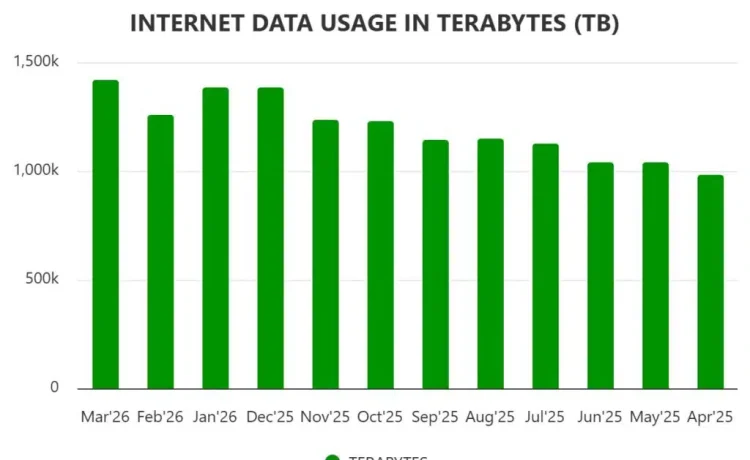
Nigeria’s digital economy continues to expand rapidly as internet data consumption rose by 44 percent over a 12-month period, reaching approximately 1.5 million terabytes by May 2026.
The latest figures from the Nigerian Communications Commission show that monthly data consumption increased from about 1.04 million terabytes in June 2025 to approximately 1.50 million terabytes in May 2026.
The increase represents roughly 460,000 additional terabytes of data moving across Nigeria’s telecommunications networks.
More Nigerians are going online
The growth reflects the increasing role of internet connectivity in everyday Nigerian life.
Consumers use mobile data for social media, entertainment, banking, shopping and education.
Businesses increasingly depend on internet connectivity for payments, marketing, customer service and remote operations.
The expansion of smartphones has also made internet access more accessible.
As devices become cheaper and digital services expand, more Nigerians are spending more time online.
Businesses are becoming more digital
For Nigerian businesses, the increase in data consumption represents both an opportunity and a challenge.
Businesses can reach customers through digital platforms.
They can use social media to market products.
They can accept digital payments.
They can operate online stores.
They can also provide customer support through messaging platforms.
The growth of data usage suggests that these activities are becoming increasingly important.
Streaming and entertainment
Entertainment is another major contributor.
Video streaming requires significantly more data than traditional text-based internet usage.
Platforms such as YouTube, Netflix and social media video services have changed how Nigerians consume content.
Short-form video has also exploded in popularity.
For telecommunications companies, this creates both opportunities and infrastructure demands.
Pressure on networks
More data consumption requires stronger network infrastructure.
Telecom operators must invest in additional capacity.
They need more base stations.
They require fibre-optic networks.
They also need reliable electricity to operate network infrastructure.
The cost of building and maintaining these systems can be significant.
This creates a difficult commercial balance.
Consumers want affordable data.
Operators need sufficient revenue to fund network expansion.
Nigeria’s digital business opportunity
The growth in data consumption is important for startups.
Digital businesses need customers who are connected.
Fintech companies require internet access.
E-commerce platforms depend on digital transactions.
Online education requires connectivity.
Cloud-based businesses need reliable networks.
As internet usage increases, the addressable market for these businesses also grows.
Challenges remain
The data-consumption growth should not be interpreted as evidence that Nigeria has solved its connectivity problems.
Many Nigerians still experience poor network quality.
Rural areas can have limited broadband access.
Data affordability remains a concern for low-income households.
Businesses also complain about the cost of connectivity.
The quality of infrastructure therefore needs to improve alongside demand.
The wider economic impact
Nigeria’s growing internet usage has implications for employment and productivity.
A stronger digital economy can create opportunities for software developers, designers, digital marketers, online educators and entrepreneurs.
It can also allow Nigerian companies to serve customers outside the country.
That is particularly important because digital exports can generate foreign exchange without requiring physical shipments.
The latest data therefore provides a useful indicator of Nigeria’s digital transformation.
The country is becoming increasingly dependent on connectivity.
The next challenge is ensuring that infrastructure, affordability and digital skills grow quickly enough to meet that demand.