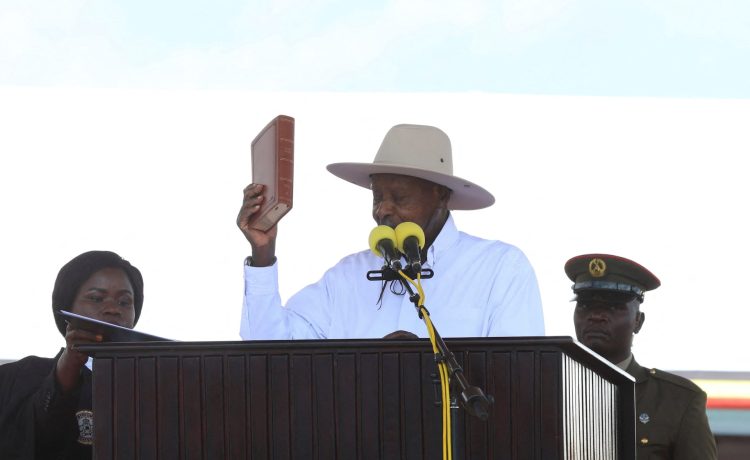
Yoweri Museveni has been sworn in for a seventh consecutive term as president of Uganda, extending his nearly four-decade rule following victory in the country’s disputed January elections.
The 81-year-old leader, who first took power in 1986 as a rebel commander, was inaugurated on Tuesday at the Kololo Independence Grounds in Kampala amid tight security and a heavy deployment of armoured vehicles across the city.
According to election authorities, Museveni secured more than 70 per cent of the votes cast, with his new tenure expected to run until 2031.
His main challenger, Bobi Wine, rejected the outcome of the election, alleging widespread irregularities and ballot manipulation.
Wine, whose real name is Robert Kyagulanyi Ssentamu, described the election results as “fake” and accused the government of undermining democracy.
The opposition figure later fled the country, claiming he feared for his safety.
“The regime wanted to eliminate me,” he reportedly said after leaving Uganda.
Election officials, however, denied allegations of fraud and insisted that the polls were conducted fairly.
Museveni is now among Africa’s longest-serving leaders, alongside figures such as Denis Sassou Nguesso, Teodoro Obiang Nguema Mbasogo, and Paul Biya, all of whom have remained in power for decades.
Several African leaders attended the inauguration ceremony, including Samia Suluhu Hassan, Félix Tshisekedi, Salva Kiir Mayardit, and Hassan Sheikh Mohamud.
Uganda has one of the world’s youngest populations, with many citizens having known no other president apart from Museveni.
Although the Ugandan leader has not publicly indicated when he plans to retire, political analysts have speculated that the current tenure could be his final term in office.
Attention has increasingly turned toward his son, Muhoozi Kainerugaba, who is widely seen as a possible successor.
Kainerugaba has faced criticism over controversial social media posts targeting opposition figures, including Bobi Wine.
Meanwhile, human rights groups have continued to express concern over Uganda’s rights record and the treatment of opposition politicians after the elections.
Amnesty International recently alleged that at least 16 people were killed by security forces between January 15 and 18 during post-election unrest.
The organisation said the victims were unarmed and posed no immediate threat.
Another opposition politician, Kizza Besigye, remains in detention after his arrest in late 2024.
Besigye was charged in a military court over allegations related to illegal weapons possession and attempts to procure arms abroad, claims he has denied.
The Ugandan government has also faced criticism over a recently passed Sovereignty Bill, which criminalises activities considered to promote “the interests of a foreigner against those of Uganda” and labels recipients of foreign funding as “agents of foreigners.”