Egypt is facing a strategic decision as China and the United States compete for a proposed artificial intelligence data centre project, placing the North African country at the intersection of technology, investment and geopolitical rivalry.
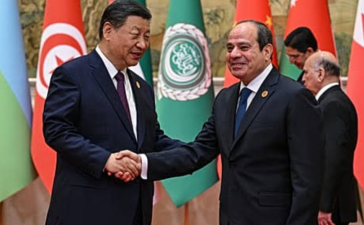
The development comes as Chinese President Xi Jinping visits Egypt, a trip that has renewed attention on the country’s expanding economic relationship with China and its longstanding defence partnership with the United States.
According to a September 4, 2026 report by Al Jazeera, Chinese technology giant Huawei has submitted a tender to build AI data centres in Egypt, while the United States is reportedly preparing a counteroffer involving American technology companies.
The proposed project highlights the growing importance of AI infrastructure in global competition, as countries seek access to the computing capacity needed to develop and deploy advanced artificial intelligence systems.
Huawei’s proposal reportedly includes 1,408 Ascend 950 processors for AI model training, alongside 600 Ascend 950 or older 910B chips for two computing clusters.
The proposed infrastructure would be used for military, surveillance and other public-sector operations, according to documents reviewed by Bloomberg and cited in the report.
The United States is reportedly considering a competing offer involving companies including Nvidia, Advanced Micro Devices and Microsoft.
Egypt balances China and US interests
The competition places Egypt in a delicate position.
China is one of Egypt’s largest economic partners, while the United States remains a major defence and strategic partner. Egypt also receives approximately $1.3bn annually in US military aid, according to the report.
At the same time, Cairo has been strengthening its economic and military ties with Beijing in recent years.
The proposed AI data centre project therefore goes beyond the supply of computer equipment. It could also deepen the influence of whichever country secures the contract.
Mohamed Ramadan, a human rights advocate with the Egyptian Initiative for Personal Rights, told Al Jazeera that the competition over data centres was significant because it involved data and the ability of countries to integrate information from different regions.
He said Huawei could have an advantage because it has operated in Egypt for years and has signed several agreements with the Egyptian government.
The report also noted that Chinese companies may be able to offer lower prices than their American competitors.
Investment benefits and environmental concerns
While the project could strengthen Egypt’s technology infrastructure, questions remain about its potential economic and environmental impact.
Data centres require substantial electricity and cooling capacity, making water and energy availability important considerations.
Egypt is already facing water scarcity. Government data cited in the report puts the country’s per capita water share below 500 cubic metres annually, less than half the United Nations’ water poverty threshold.
Cairo also faces significant air pollution challenges.
The proposed AI infrastructure could therefore place additional pressure on resources if it requires large quantities of water and electricity.
Egyptian political analyst Maged Mandour told Al Jazeera that the government would likely provide the resources needed for the project, but questioned whether the investment would generate significant long-term employment.
He argued that the deal could amount largely to an export arrangement for AI technology rather than an economically transformative project.
The debate reflects a wider question facing countries seeking to attract AI investment: whether data centres can generate broad economic benefits or primarily serve as infrastructure for foreign technology companies.
Why Egypt matters to China
Egypt’s geographic position is another factor behind the competition.
The country controls the Suez Canal and sits at the crossroads of Africa, the Middle East, Europe and Asia.
That location makes Egypt an important market and a potential manufacturing and logistics hub for Chinese companies seeking access to surrounding regions.
China is Egypt’s largest trading partner in non-petroleum goods, with bilateral trade reaching nearly $20.7bn by the end of 2025, according to Egypt’s State Information Service.
The report also said Egypt imported approximately $10bn in Chinese goods during the first half of 2026, representing an increase of more than 14 per cent from the same period a year earlier.
Chinese investment has expanded since Egyptian President Abdel Fattah el-Sisi signed a strategic partnership agreement with Beijing in 2014.
Chinese companies have since invested in projects involving container ports, green hydrogen, factories and other industries.
The China-Egypt Suez Economic and Trade Cooperation Zone has also attracted more than 200 companies and created over 10,000 direct jobs, according to figures cited by China’s Xinhua news agency.
A decision with wider implications
The proposed AI data centre project is therefore part of a broader contest over technology, infrastructure and influence.
For Egypt, the decision will involve balancing economic opportunities with strategic relationships and domestic resource constraints.
The outcome could also signal how countries in Africa and the Middle East navigate the growing competition between China and the United States over artificial intelligence.
As AI becomes increasingly important to national security, public services and economic development, the choice of technology partners is likely to carry implications far beyond the construction of data centres.