
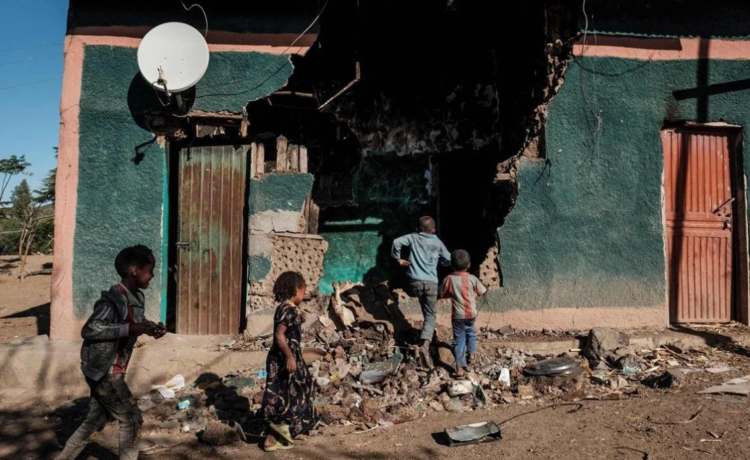
Amnesty International has called for an independent investigation into artillery attacks that killed civilians in Alamata, a city in Ethiopia’s northern Tigray region, warning that the incidents may constitute war crimes.
In an investigation published on November 23, 2026, the human rights organisation said it independently verified the deaths of 14 civilians in four artillery attacks carried out between September 26 and 28.
The attacks occurred during renewed fighting involving the Ethiopian National Defence Force (ENDF), its allied Tigray Peace Forces (TPF) and forces associated with the Tigray People’s Liberation Front (TPLF).
Amnesty said the artillery strikes affected residential neighbourhoods and commercial areas, raising serious concerns about the protection of civilians during military operations.
The organisation interviewed 28 people, including survivors, eyewitnesses, relatives of victims, humanitarian workers and medical personnel.
It also examined videos, photographs, satellite imagery and other publicly available evidence as part of its investigation.
Amnesty’s findings have renewed attention on the humanitarian situation in Tigray and the risks facing residents as armed confrontations continue in northern Ethiopia.
Four artillery attacks investigated
According to Amnesty International, the four incidents examined occurred in different parts of Alamata between September 26 and 28.
One of the most heavily affected locations was the condominium neighbourhood in Kebele 04, where artillery reportedly struck residential properties.
Witnesses told the organisation that an attack on September 27 killed seven people and injured four others.
Among those killed were a 26-year-old woman, her eight-year-old son and her older brother.
The same attack also killed four members of a neighbouring family.
Another incident involved an artillery strike on a local bar known as Nigus Shimoy on September 26.
The attack reportedly occurred around 11am, when people were gathered in a commercial area near a market.
A survivor and another witness told Amnesty that at least three people were killed.
The organisation also documented an attack on a family home in Kebele 02, where a 55-year-old woman was reportedly killed and several relatives were seriously injured.
Amnesty said the incidents raised concerns about the use of weapons with wide-area effects in densely populated civilian neighbourhoods.
Concerns over military positions near civilians
The investigation also raised concerns about the presence of TPLF-affiliated fighters in civilian areas before and during the renewed fighting.
According to Amnesty, several residents said schools in Alamata had been used as military bases in the months before the conflict escalated.
The organisation said placing military objectives within or near densely populated civilian areas can increase the risks facing residents.
International humanitarian law requires parties to armed conflicts to take precautions to protect civilians and avoid placing military objectives close to civilian populations where feasible.
Amnesty also examined allegations that some attacks occurred in locations where residents said there was no military presence.
However, the organisation acknowledged that it could not independently verify every military movement or the precise circumstances surrounding each strike.
Military authorities asked to respond
Amnesty International said it wrote to the Ethiopian National Defence Force, the Tigray Peace Forces and the TPLF on October 27, requesting information about the incidents.
On November 17, the organisation shared its investigation findings with the ENDF and TPF and invited them to provide comments.
The organisation said the ENDF and TPF had not responded by the time the investigation was published.
The TPLF, however, sent a four-page response on November 18, rejecting allegations directed against its forces and calling for further independent and impartial investigations.
Amnesty maintained that all allegations involving civilian harm should be investigated independently.
Renewed conflict raises humanitarian concerns
The renewed fighting in Tigray has increased fears of another major humanitarian crisis in northern Ethiopia.
The region experienced a devastating war between 2020 and 2022, which resulted in widespread displacement, destruction of infrastructure and serious allegations of human rights violations.
The renewed confrontation began on September 21, 2026, and spread across several areas involving Tigray, Amhara and Afar regions.
The situation has also raised concerns about possible wider regional instability, particularly amid tensions involving Ethiopia and Eritrea.
Alamata is strategically important because of its location and role as a supply route for troops, food and fuel.
Its civilian population remains exposed to the consequences of renewed military operations.
Calls for accountability
Amnesty International has urged relevant authorities to investigate the attacks and ensure that anyone responsible for violations of international humanitarian law is held accountable.
The organisation has also called on all parties to the conflict to take measures to protect civilians, avoid indiscriminate attacks and respect international humanitarian obligations.
The findings underline the importance of independent investigations in conflict situations, particularly where civilians are killed or injured.
As fighting continues to threaten stability in northern Ethiopia, the protection of civilian lives and access to humanitarian assistance remain urgent priorities.