
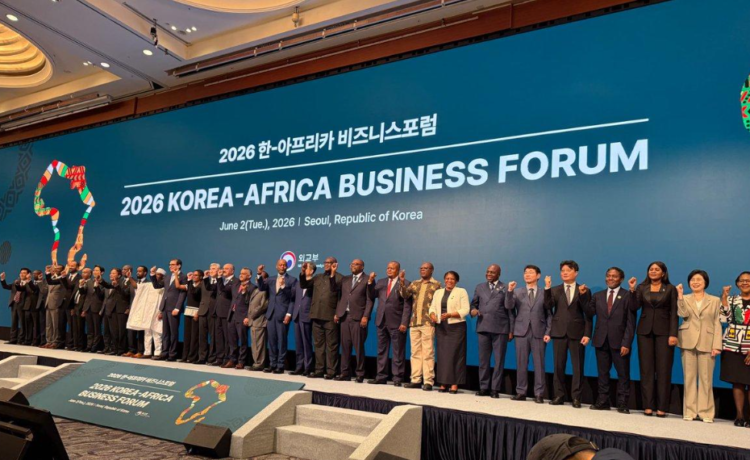
South Korean companies have generated approximately $270 million in export and project-order consultations across seven African countries following a five-month economic cooperation programme designed to strengthen trade and investment relations with the continent.
The programme was implemented by South Korea’s Ministry of Trade, Industry and Energy in partnership with the Korea Trade-Investment Promotion Agency (KOTRA).
According to a report published by BusinessKorea on November 26, 2026, the initiative began in July and involved approximately 150 South Korean companies and 400 African businesses and institutions.
The participating organisations explored opportunities in manufacturing, infrastructure, energy, consumer goods and other commercial sectors.
Countries involved included Côte d’Ivoire, Tanzania and Algeria, alongside other African markets.
The development highlights growing interest among South Korean businesses in Africa’s expanding consumer market, natural resources, infrastructure requirements and industrial development opportunities.
Energy and infrastructure attract major interest
Energy and infrastructure accounted for a significant proportion of the commercial discussions.
South Korean companies participated in consultations in Tanzania and Mozambique, where 10 machinery and energy companies explored project opportunities worth approximately $250 million.
The discussions focused on power generation, energy equipment and other infrastructure-related opportunities.
Tanzania Electric Supply Company also communicated the need for international companies with the technical capabilities and ability to meet delivery schedules required for a national power grid interconnection project.
The interest demonstrates the importance of reliable electricity infrastructure to African economies seeking to expand industrial production and improve access to energy.
For South Korean businesses, the continent offers opportunities to supply machinery, engineering services, power equipment and technical solutions.
For African countries, partnerships with international manufacturers could support infrastructure development and strengthen domestic industrial capacity.
Nineteen agreements signed
The programme also generated commercial agreements in export and distribution.
A total of 19 export and distribution network entry agreements were signed during the activities, according to the report.
South Korean consumer goods companies also explored opportunities in African markets, particularly in beauty products and cosmetics.
The popularity of Korean consumer products has continued to expand internationally, and Africa is increasingly becoming an important market for these businesses.
South Korea’s cosmetics exports to Africa reportedly increased from $5.76 million in 2022 to $27 million in 2025.
This represented an average annual growth rate of approximately 67 per cent over the three-year period.
KOTRA and the trade ministry also organised promotional events and pop-up stores in markets including Kenya and Nigeria.
Products from 113 South Korean companies were introduced to African buyers through these activities.
A distribution company in Côte d’Ivoire also indicated plans to expand its Korean beauty pop-up stores to two locations within the year.
The development illustrates the growing potential of Africa’s consumer market for foreign brands.
Algeria attracts manufacturing interest
In North Africa, Algeria emerged as an important destination for discussions involving manufacturing and industrial partnerships.
The South Korean delegation explored opportunities in automobile components, industrial machinery and local production facilities.
The discussions were influenced by Algeria’s efforts to strengthen domestic manufacturing and reduce dependence on imported fully assembled vehicles.
South Korean businesses are interested in supplying automobile parts and industrial equipment while exploring opportunities to establish local production arrangements.
Such partnerships could support technology transfer, local employment and the development of manufacturing supply chains.
For African economies, attracting foreign manufacturers can provide access to technical knowledge, production systems and international distribution networks.
Africa’s growing market attracts investors
The growing interest in Africa is supported by the continent’s large population, expanding consumer demand and infrastructure requirements.
The African Development Bank has projected economic growth of 4.6 per cent for the continent in 2026, above the global average of 3.2 per cent cited in the report.
Africa also has a young population, with approximately 59 per cent of its people under the age of 25.
This demographic structure creates opportunities for businesses involved in consumer products, education, technology, housing, transportation and other services.
However, companies seeking to expand into African markets must also consider challenges such as infrastructure gaps, regulatory differences, foreign exchange risks and variations in consumer purchasing power.
Nigeria and other African countries stand to benefit
Nigeria is among the markets targeted by South Korean companies, particularly in consumer products and commercial distribution.
The country’s large population and expanding retail market offer opportunities for international businesses seeking to introduce new products and establish local partnerships.
South Korean companies could also explore opportunities in Nigeria’s manufacturing, technology and infrastructure sectors.
For African businesses, international partnerships can provide access to new markets, investment and technical expertise.
KOTRA said it would continue focusing on commercial opportunities tailored to the demands of individual African markets.
The agency also conducted online consultations in November to maintain engagement with buyers in countries including South Africa.
Outlook for trade relations
The $270 million in consultations represents a significant indication of commercial interest, although consultation values should not be confused with completed investment or realised sales.
The next stage will involve converting the discussions into actual contracts, project implementation and sustained business relationships.
If successfully converted, the opportunities could strengthen trade relations, expand industrial cooperation and create new commercial opportunities across Africa.
The programme also demonstrates how international partnerships can support African countries seeking to diversify trade, attract investment and strengthen domestic production.