At least seven people have been killed and more than 100 others injured following a collision involving two passenger trains south of Egypt’s capital, Cairo, renewing concerns about railway safety and the condition of the country’s transport infrastructure.
The accident occurred on Sunday, November 8, 2026, in the Al-Ayyat area of Giza Governorate, where two passenger trains collided, causing several carriages to derail.
According to reports citing Egypt’s health authorities, seven people lost their lives while more than 100 passengers sustained injuries of varying degrees.
Emergency response teams were deployed to the scene to rescue trapped passengers, provide medical assistance and transport injured victims to nearby hospitals.
The incident caused significant disruption to railway operations in the affected area as authorities worked to secure the location and investigate the circumstances surrounding the collision.
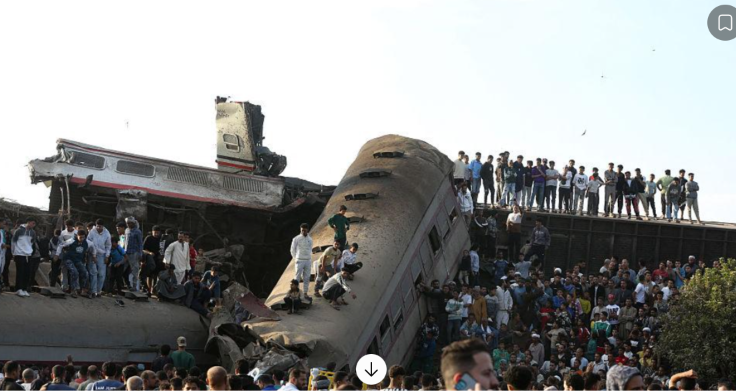
Images from the accident showed damaged railway carriages and derailed sections of the trains, highlighting the seriousness of the incident.
Following the crash, railway workers began repair activities on the damaged tracks on Monday, November 9, as authorities worked to restore normal operations.
The accident has renewed public attention on railway safety in Egypt, a country that relies heavily on rail transportation to move millions of passengers between major cities and communities.
Rail transport remains an important part of Egypt’s public transportation system because it provides relatively affordable movement for workers, students, traders and other travellers.
However, the country has experienced several serious railway accidents over the years, raising questions about infrastructure maintenance, operational supervision and the effectiveness of safety regulations.
The latest collision has therefore intensified calls for stronger measures to prevent similar incidents.
Railway safety requires effective coordination between train operators, signalling systems, track maintenance teams and other relevant authorities.
Accidents involving multiple trains can result from different factors, including signalling failures, human error, communication problems, equipment defects or infrastructure weaknesses.
However, the exact cause of Sunday’s collision had not been established in the reports available on November 10.
It would therefore be premature to attribute responsibility to any particular individual, railway worker or institution before the investigation is completed.
Egyptian authorities are expected to examine the circumstances surrounding the accident to determine what happened and identify any possible safety failures.
The investigation will also be important in establishing whether existing railway operating procedures were followed before the collision.
Beyond the immediate emergency response, the accident raises broader concerns about the long-term management of railway infrastructure.
Egypt has previously announced efforts to modernise its railway system through investments in new trains, improved signalling technology and infrastructure upgrades.
These programmes are intended to improve passenger safety, increase operational efficiency and reduce the risk of railway accidents.
Nevertheless, the latest tragedy demonstrates the importance of ensuring that modernisation efforts translate into effective safety improvements across the entire railway network.
Railway authorities must also ensure that employees receive appropriate training, safety procedures are regularly reviewed and maintenance activities are carried out consistently.
For passengers, the most immediate concern remains the safety of everyday journeys.
Families affected by the accident are also facing the difficult task of dealing with injuries, deaths and the uncertainty surrounding the recovery of their loved ones.
The government will face pressure to provide answers about the incident and demonstrate that appropriate steps are being taken to prevent another tragedy.
The collision also highlights the importance of transparent investigations and public communication following major transport accidents.
As railway operations gradually resume in the affected area, attention is expected to remain on the condition of the damaged tracks, the findings of the investigation and any additional safety measures introduced by the authorities.
The latest incident is another reminder that investment in transportation infrastructure must be accompanied by strict safety monitoring, effective maintenance and strong accountability.
For Egypt, restoring public confidence in its railway system will require not only repairing damaged infrastructure but also demonstrating that passenger safety remains a central priority.