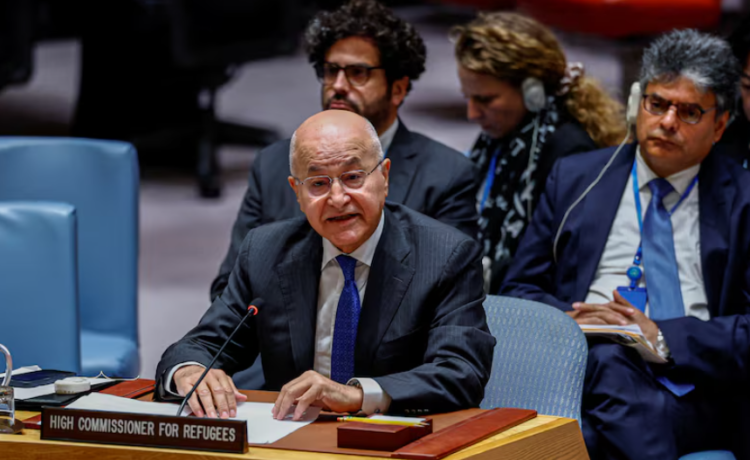
The United Nations refugee agency, UNHCR, has warned that nearly 8.3 million refugees and forcibly displaced people could be left without essential assistance this year because of a severe funding shortage.
The agency said it is facing a $5.789 billion funding gap, one of the largest financial shortfalls in its history. By July 2026, UNHCR had received only 32% of the $8.505 billion it said was required for the year.
The funding crisis is particularly concerning for African countries dealing with large refugee populations and ongoing conflicts.
In Chad, which has received hundreds of thousands of people fleeing the war in neighbouring Sudan, about 319,000 refugees face delays in registration. UNHCR also warned that approximately 200,000 women and girls could lose access to safe spaces and programmes designed to prevent gender-based violence.
In Sudan, where the ongoing civil war has created one of the world’s largest displacement crises, about 140,000 refugees and asylum seekers remained unregistered by the middle of 2026 after registration activities were suspended for several months.
UNHCR said registration is important because undocumented refugees can face difficulties accessing protection, healthcare, education and other essential services.
The agency also warned that funding reductions have already forced it to take significant cost-cutting measures. UNHCR reduced its workforce by 33% in 2025, closed offices in 140 locations and discontinued operations in 15 countries compared with 2024.
UNHCR said the number of refugees, displaced people and stateless people under its mandate is expected to reach 131.2 million by the end of 2026, up from 129.4 million at the end of 2025.
The agency has warned that further cuts could affect services for children, refugees requiring documentation and survivors of gender-based violence.
Another challenge is that an increasing proportion of donor funding is specifically earmarked for particular programmes or locations. UNHCR said tightly earmarked funding accounted for 51% of its funding in 2026, compared with 19% five years earlier. This limits the agency’s ability to move money quickly to emergencies where needs are greatest.
UNHCR said its existing cost-saving measures cannot fully compensate for the funding shortfall and warned that continued reductions could weaken refugee protection systems in countries already struggling with large displaced populations.