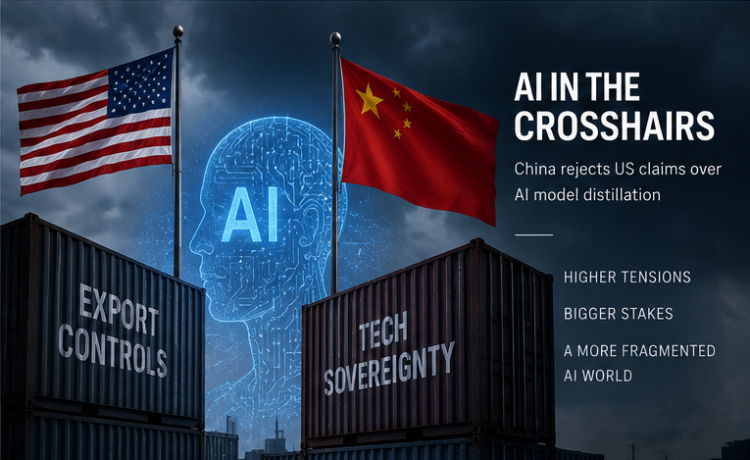
China has rejected allegations by US intelligence and cybersecurity agencies that leading Chinese artificial intelligence companies conducted large-scale campaigns to extract capabilities from American frontier AI models.
The dispute adds another dimension to the widening technology rivalry between Washington and Beijing, where semiconductors, AI models, data centres and intellectual property are increasingly being treated as national-security assets.
The US National Security Agency, Federal Bureau of Investigation and Cybersecurity and Infrastructure Security Agency issued a joint advisory accusing China-based AI developers of conducting what they described as industrial-scale model distillation against American systems.
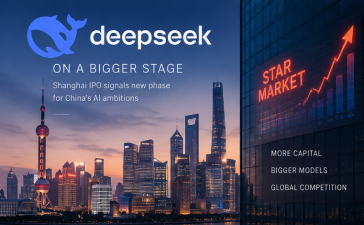
The advisory named DeepSeek, Alibaba, Moonshot AI and Z.ai.
What Is AI Distillation?
Model distillation is a recognised technique in artificial intelligence.
It generally involves using outputs from a larger or more capable AI model to help train a smaller model to reproduce some of its behaviour.
The technique itself is widely used legitimately by researchers and technology companies.
The US agencies, however, alleged that some Chinese companies systematically extracted restricted capabilities from US frontier models while circumventing terms of service and other restrictions.
The advisory said those activities had occurred since at least late 2024 and involved models developed by companies including OpenAI, Anthropic and Google.
It also said the operations were conducted with likely awareness by Chinese authorities, an allegation Beijing has rejected.
Beijing Calls Claims Unfounded
China’s Foreign Ministry urged Washington to stop what it described as unfounded accusations against Chinese technology companies.
Foreign Ministry spokesperson Mao Ning said China’s progress in artificial intelligence was based on innovation and argued that the world’s two largest AI powers should increase cooperation rather than confrontation.
The Chinese government has previously rejected similar accusations involving intellectual-property theft and government-backed technology acquisition.
The latest dispute is likely to intensify debate over where legitimate learning from commercially available AI systems ends and unauthorised extraction of proprietary capabilities begins.
AI Becomes National Security Issue
That distinction is becoming increasingly important because AI models are no longer viewed solely as commercial software.
Washington increasingly treats advanced AI systems and the high-end chips used to train them as strategic technologies with potential military, intelligence and cybersecurity applications.
The United States has already tightened export restrictions on advanced semiconductors and semiconductor manufacturing technology to China.
The distillation accusations suggest Washington is now focusing more closely on whether model capabilities themselves can be transferred indirectly, even when Chinese developers cannot access the most advanced US hardware.
For Beijing, such restrictions reinforce its determination to build domestic AI systems, chips and infrastructure.
Dispute Comes Ahead of Trump-Xi Talks
The confrontation also arrives ahead of expected discussions between US President Donald Trump and Chinese President Xi Jinping.
Artificial intelligence governance, semiconductor access and wider technology restrictions are expected to remain important issues in the relationship between the two countries.
The stakes extend beyond individual companies.
If governments increasingly treat model outputs, training methods and AI capabilities as strategically sensitive technology, the global AI industry could become more fragmented.
US and Chinese developers may find themselves operating within increasingly separate technological ecosystems shaped by national-security rules as much as commercial competition.