SIFAX Shipping Bonded Terminal has commissioned a new office complex at its operational base on Ago Palace Way, Okota, Lagos, as part of efforts to strengthen service delivery, improve workplace efficiency and deepen collaboration with regulatory agencies.
The facility will accommodate SIFAX Shipping staff as well as officials of government agencies operating at the terminal, including the Nigeria Customs Service and the National Drug Law Enforcement Agency, NDLEA.
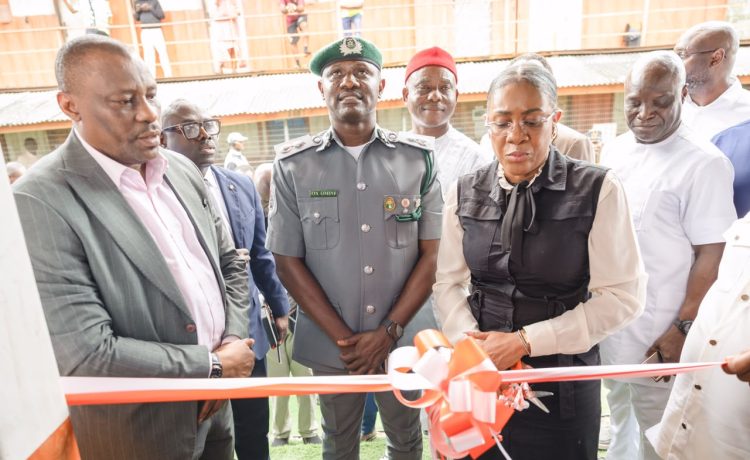
The building was officially commissioned by Mrs Wunmi Eniola-Jegede, Group Coordinating Director of SIFAX Group, on behalf of the Group’s Executive Chairman, Dr Taiwo Afolabi.
The ceremony brought together senior executives of SIFAX Group, maritime industry stakeholders, regulatory agencies, clearing agents and other partners in the logistics value chain.
Afolabi Says Focus Must Be on Service Delivery
In his address, Afolabi commended the project team, contractors, consultants and management for completing the facility within what he described as a remarkable timeframe.
He said the value of the new complex would ultimately be determined by the quality of service delivered from the facility rather than its physical appearance.
“As we celebrate this achievement, the true value of this building will not be measured by its appearance, but by what we accomplish within its walls,” Afolabi said.
He urged personnel who will work in the facility to make it a centre of excellence driven by professionalism, innovation, teamwork, accountability and exceptional customer service.
The emphasis on operational performance reflects the broader role of bonded terminals in Nigeria’s maritime and logistics chain, where the efficiency of documentation, cargo examination, customs processes and interaction between terminal operators and government agencies can directly affect the movement of goods.
New Facility to Strengthen Collaboration
Managing Director of SIFAX Shipping Bonded Terminal, Mr Kayode Kolade, said the project was delivered through careful planning, strategic investment by the company’s board and cooperation among relevant stakeholders.
Kolade said the new working environment was expected to improve productivity while creating stronger coordination between the terminal operator and agencies responsible for cargo clearance and regulation.
“As we commission this building today, our focus goes beyond this beautiful facility we see,” he said.
“We are looking forward to what this new environment will enable us to achieve — better service delivery, greater productivity, stronger collaboration and new opportunities for growth.”
Housing terminal personnel and regulatory officials within the same operational environment could help reduce administrative bottlenecks and improve coordination in areas such as documentation, cargo inspection and compliance.
Investment Comes Amid Push for More Efficient Port Logistics
The commissioning comes as operators across Nigeria’s maritime and logistics industry continue to invest in infrastructure and operational improvements aimed at reducing delays and strengthening cargo evacuation.
Bonded terminals play an important role in the port ecosystem by providing approved locations outside the immediate port environment where imported cargo can be transferred, stored, examined and cleared under Customs supervision.
Their efficiency can therefore influence cargo dwell time, logistics costs and the overall competitiveness of Nigeria’s trade environment.
For private terminal operators, investment in office infrastructure may appear less visible than acquiring cargo-handling equipment, but administrative efficiency can be equally important in a sector heavily dependent on coordination among Customs, security agencies, freight forwarders and terminal personnel.
Customs, ANLCA Representatives Attend
Among stakeholders present at the commissioning were Deputy Comptroller O.A. Omini, who led the Nigeria Customs Service delegation, and Mr Wale Cole, Chairman of the Association of Nigerian Licensed Customs Agents, ANLCA.
Clearing agents and management staff of SIFAX Group subsidiaries also attended the event.
Their presence reflected the multiple stakeholders involved in the daily movement of cargo through bonded terminal facilities.
For SIFAX Shipping, the new office complex is therefore both an infrastructure investment and an attempt to create a more coordinated working environment for organisations involved in terminal operations.
The success of the project will ultimately be measured by whether the improved facility translates into faster processes, stronger stakeholder cooperation and a better experience for customers using the terminal.