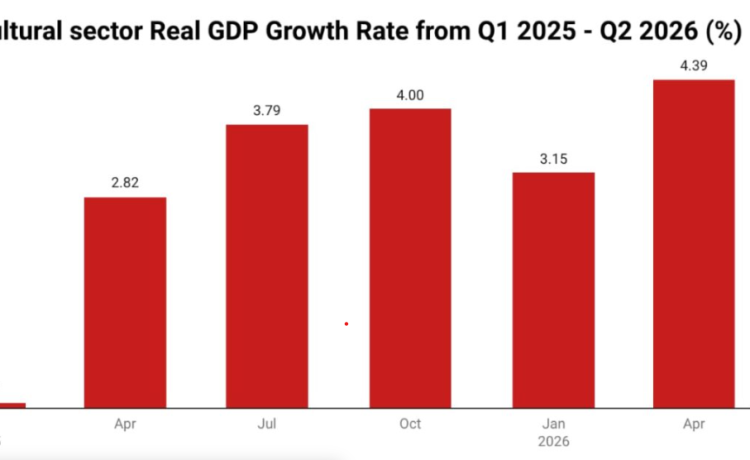
Nigeria’s agricultural sector recorded a significant improvement in the second quarter of 2026, growing by 4.39 per cent year-on-year, according to the latest report from the National Bureau of Statistics (NBS).
The growth represents a major improvement compared with the 2.82 per cent recorded in the second quarter of 2025 and the 3.15 per cent recorded in the first quarter of 2026. Agriculture was also one of the sectors that supported Nigeria’s overall economic expansion during the period.
The NBS reported that Nigeria’s real Gross Domestic Product (GDP) grew by 4.43 per cent in Q2 2026, compared with 4.23 per cent in the same period of 2025. The agricultural sector contributed 26.15 per cent to real GDP during the quarter, making it the second-largest broad sector after services.
Crop production remains important
Crop production remained a major driver of agricultural activity. The sector also recorded stronger performances in livestock, forestry and fishing.
Livestock was particularly notable, recording 6.92 per cent growth during the quarter, while forestry grew by 4.88 per cent and fishing increased by 2.16 per cent. Crop production grew by 3.66 per cent.
The improvement in agriculture is important for Nigeria because the sector provides employment and income for millions of people and plays a major role in the country’s food supply.
Insecurity and rising costs remain concerns
Despite the stronger growth figures, Nigerian farmers continue to face major challenges.
Insecurity in some farming communities remains a threat to agricultural production, while high prices of fertiliser, seeds, machinery, transportation and other farm inputs continue to increase production costs.
Farmers also face climate-related pressures, inadequate storage facilities, limited access to affordable finance and difficulties transporting agricultural produce from rural communities to major markets.
These challenges mean that higher agricultural output does not automatically translate into cheaper food or higher incomes for farmers.
Agriculture supports wider economic growth
The improvement in agriculture contributed to the broader expansion of Nigeria’s non-oil economy. The non-oil sector grew by 4.31 per cent in Q2 2026, with agriculture, telecommunications, trade, financial services, real estate, manufacturing and construction among the activities supporting growth.
However, analysts say sustained investment will be necessary if Nigeria wants agricultural growth to translate into stronger food security, better farmer incomes and more jobs.
Improving irrigation, rural roads, storage, processing facilities and access to agricultural finance could help farmers increase productivity and reduce post-harvest losses.
The latest figures therefore provide some positive news for Nigeria’s agricultural sector, but maintaining the momentum will depend on how effectively the government and private sector address the challenges facing farmers.