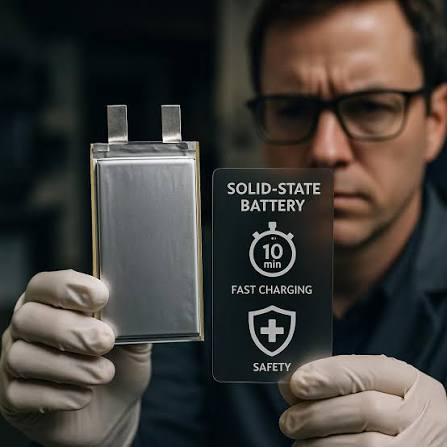
The United States is committing $500 million in grants to battery startups and companies working across the domestic energy-storage supply chain.
The funding represents another major government effort to strengthen the country’s position in battery technology.
Batteries have become strategically important because they support electric vehicles, renewable energy storage, consumer electronics and defence systems.
The growing importance of artificial intelligence has also increased demand for reliable electricity and energy infrastructure.
Why battery technology matters
Modern economies depend increasingly on energy storage.
Renewable energy sources such as solar and wind do not produce electricity continuously.
Battery systems can store electricity when production is high and release it when demand increases.
Electric vehicles also depend on advanced batteries.
Therefore, improvements in battery technology can influence several industries simultaneously.
Reducing foreign dependence
The US government says the funding is intended partly to reduce reliance on foreign sources.
Battery supply chains are globally interconnected.
Important minerals and components are concentrated in particular countries.
Manufacturing capacity is also unevenly distributed.
That creates potential vulnerabilities.
If geopolitical tensions disrupt supplies, companies could struggle to obtain essential components.
Building domestic capacity can therefore be viewed as both an economic and national-security strategy.
Startups receive critical support
Startups often struggle to finance energy technology development.
Unlike software companies, battery businesses require physical infrastructure.
They need laboratories, manufacturing equipment and testing facilities.
That can make early-stage funding particularly difficult.
Government grants can provide the capital required to move promising technologies from laboratories to commercial production.
The $500 million programme could therefore help companies cross what is often called the “valley of death” between research and commercialisation.
Competition with China
China has become a dominant player in battery manufacturing.
Chinese companies control significant portions of global battery production and supply chains.
The US and other Western economies are therefore attempting to build alternatives.
Europe has also been investing heavily in domestic battery manufacturing.
The competition is likely to intensify as demand for electric vehicles and energy storage increases.
AI creates another demand source
Artificial intelligence is also changing the energy equation.
AI data centres consume enormous amounts of electricity.
As companies build larger computing facilities, energy storage could become increasingly important.
Battery systems can help data centres manage power fluctuations and provide backup electricity.
This creates a potential connection between two of the technology industry’s biggest investment trends: AI and energy storage.
Africa’s opportunity
The global battery boom could create opportunities for African countries.
Africa possesses significant mineral resources needed for battery production.
However, exporting raw minerals provides less economic value than processing and manufacturing.
Countries across the continent could therefore seek to attract investment in refining, battery components and energy-storage systems.
Nigeria also has an opportunity to participate.
The country is already developing interest in electric mobility and renewable energy.
A stronger domestic battery ecosystem could support electric motorcycles, vehicles and off-grid power systems.
The road ahead
The US investment demonstrates that battery technology is no longer simply a climate issue.
It is also an industrial and strategic technology priority.
Companies capable of developing cheaper, safer and more efficient batteries could become extremely valuable.
Government funding can accelerate that development.
However, long-term success will depend on whether startups can eventually produce commercially competitive products.