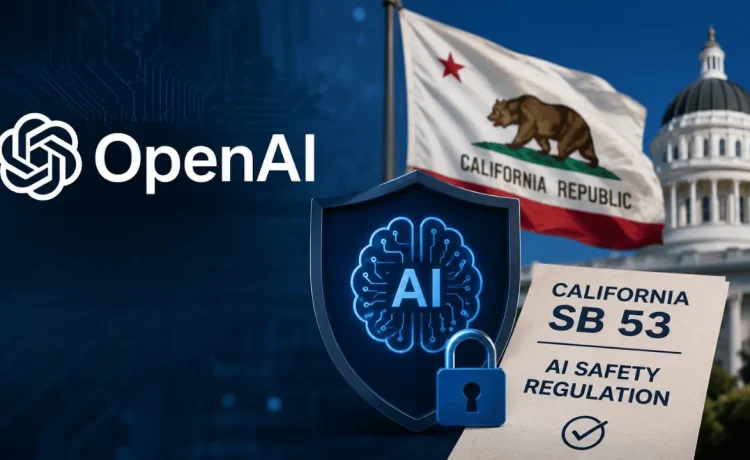
OpenAI has changed its position on California’s artificial intelligence safety legislation, saying it now supports stronger safeguards for advanced AI systems.
The change represents an important development in the growing debate over how governments should regulate frontier artificial intelligence.
OpenAI previously opposed the legislation.
Its new position reflects the rapidly changing environment surrounding AI safety as models become more capable and increasingly integrated into business, government and everyday life.
Why the legislation matters
California is home to many of the world’s largest technology companies.
Consequently, laws passed in the state can have effects beyond its borders.
Companies operating there may develop products that are eventually distributed globally.
The legislation seeks to establish safety and accountability requirements for major AI developers.
Supporters argue that powerful AI systems should be subject to stronger safeguards.
They believe companies should be required to identify and manage risks before deploying highly capable models.
Why OpenAI changed course
OpenAI’s position appears to reflect the increasing difficulty of managing AI risks through voluntary measures alone.
The company has faced growing pressure over the safety of its models.
As systems become more capable, concerns have expanded beyond misinformation.
Researchers and policymakers are also examining cybersecurity, autonomy and the possibility that advanced AI could be used in harmful ways.
OpenAI said recent incidents have demonstrated the need for stronger protections.
State-level regulation
One of the major issues in the US is the absence of comprehensive federal AI legislation.
This has encouraged individual states to develop their own rules.
OpenAI now describes this approach as a form of “reverse federalism”.
Under such a model, states can establish standards that could eventually influence national policy.
However, technology companies have traditionally argued that inconsistent state laws could create regulatory complexity.
A company operating across all 50 states could potentially face different requirements in each jurisdiction.
What businesses need to know
AI regulation is becoming increasingly important for businesses.
Companies adopting AI systems will need to understand not only what the technology can do but also what legal responsibilities accompany its use.
Businesses may need stronger documentation.
They may also need risk assessments, human oversight and data-protection measures.
For companies developing AI products, compliance could become an important cost.
However, clear rules could also increase consumer confidence.
Nigeria’s regulatory implications
Nigeria is also developing its approach to artificial intelligence governance.
As AI adoption increases across banking, telecommunications, education and government, policymakers will face similar questions.
How should companies be held responsible for AI systems?
What level of transparency should be required?
Who should be accountable when an AI system causes harm?
The answers will influence Nigeria’s technology ecosystem.
Overly restrictive rules could discourage innovation.
Weak rules could create safety and privacy risks.
The future of AI regulation
OpenAI’s change in position demonstrates how quickly the regulatory debate is evolving.
Companies that once resisted certain rules may eventually support them as the technology becomes more powerful.
The industry may therefore be moving towards a model in which AI development is accompanied by stronger transparency and safety requirements.
For users, this could provide greater confidence.
For developers, it could create additional obligations.
For governments, it will require regulators to understand a technology that continues to evolve rapidly.