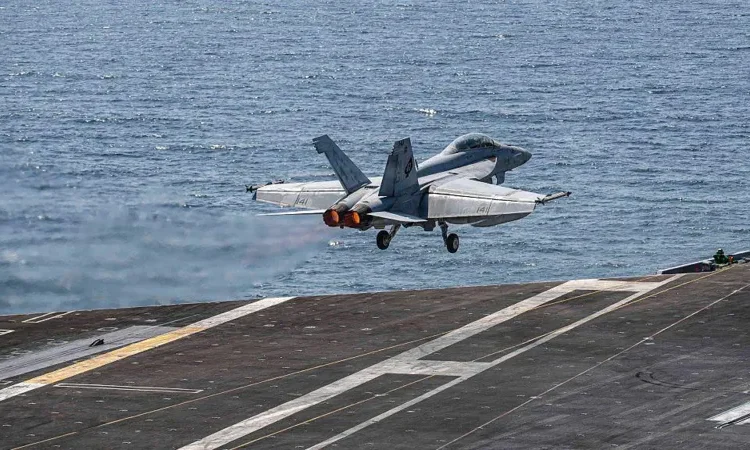
The United States military has carried out fresh strikes on Iran, targeting a military site in Bandar Abbas, a strategic port city along the Strait of Hormuz.
According to the US Central Command, the strikes were aimed at preventing what it described as an imminent drone threat in the region.
Centcom stated that US forces also shot down four Iranian one-way attack drones that posed a threat around the Strait of Hormuz.
The military said the site in Bandar Abbas was struck as it prepared to launch a fifth drone. Iranian media later reported explosions east of the city.
The latest strikes come amid a fragile ceasefire between Washington and Tehran and ongoing negotiations aimed at ending the three-month conflict that has disrupted shipping traffic through the Strait of Hormuz and driven up global energy prices.
It marks the second time in three days that the United States has launched strikes on Iranian targets, describing the operations as acts of self-defence.
Centcom said the latest military action was “measured, purely defensive, and intended to maintain the ceasefire.”
Earlier this week, the command confirmed another round of strikes in southern Iran, targeting missile sites and vessels allegedly attempting to lay mines in the Strait of Hormuz.
According to the US military, those operations were carried out to protect American troops from threats posed by Iranian forces.
Iran condemned the attacks, describing them as “a grave violation of the ceasefire” and warning that it would not ignore acts of hostility.
Meanwhile, Kuwait’s military announced on Thursday that its air defence systems intercepted what it described as hostile missile and drone threats, although it did not disclose further details.
The United States also imposed sanctions on the Persian Gulf Strait Authority, the Iranian body responsible for collecting payments from ships travelling through the Strait of Hormuz.
In a statement, the US Treasury Department warned that ships making payments to the authority could also face sanctions risks.
The Strait of Hormuz remains one of the world’s most critical energy routes, with roughly one-fifth of global liquefied natural gas and oil shipments passing through the channel.
The ongoing conflict has severely disrupted maritime traffic and intensified concerns in global energy markets.
Iranian foreign ministry spokesman Esmaeil Baqaei defended the fees collected by Tehran, saying they were for navigational services and insisting Iran would continue managing traffic through the waterway.
US Treasury Secretary Scott Bessent accused Iran of attempting to “extort global maritime trade” and claimed the move reflected Tehran’s financial desperation.
Iran’s Islamic Revolutionary Guard Corps also announced earlier this week that it had downed a US drone and fired at an American fighter jet and another drone that allegedly entered Iranian airspace.
During a cabinet meeting on Wednesday, US President Donald Trump said Iran was “negotiating on fumes” and suggested Washington could resume a broader military campaign if talks fail.
“Maybe we have to go back and finish it, maybe we don’t,” Trump said.
He also urged Gulf nations to normalise relations with Israel under the Abraham Accords framework.
Israel launched the conflict against Iran alongside the United States on February 28 and remains engaged in hostilities with Iranian-backed Hezbollah in Lebanon.
Although Trump recently said a peace deal with Iran had been “largely negotiated,” he later acknowledged that Washington remained dissatisfied with the pace and outcome of discussions.
Speaking at Wednesday’s cabinet meeting, Trump said Iran was eager to reach an agreement but warned that the US remained prepared to resume military action if negotiations collapse.
“They just want to make a deal — I don’t think they have a choice,” he said.