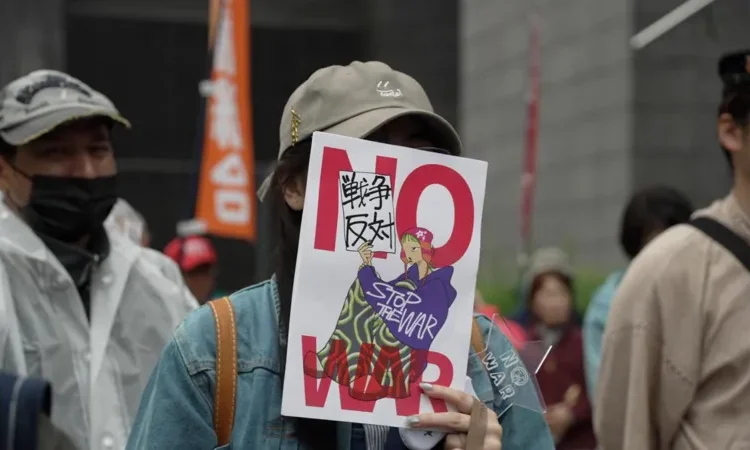
On a rain-soaked street corner in Tokyo, a large crowd gathered holding drenched placards and flags, with one message repeated in bold Japanese kanji: “No War.”
The scene reflects growing public unrest in Japan, where some of the largest anti-war protests in decades are unfolding amid concerns over the country’s shifting security posture.
Since taking office in October 2025, Prime Minister Sanae Takaichi has introduced sweeping changes that move Japan further away from its long-standing post-war pacifist stance.
Her administration has lifted restrictions on arms exports and expanded Japan’s military engagement abroad, citing rising regional security threats.
The government argues that the changes are necessary due to increasing tensions in the region involving China, North Korea, and Russia, as well as evolving expectations from the United States, Japan’s key ally.
However, the reforms have sparked widespread concern among citizens who fear the erosion of Japan’s pacifist identity.
Japan’s post-war constitution, particularly Article 9, renounces war and prohibits the maintenance of traditional armed forces. Many citizens see recent reforms as a departure from that legacy.
Public demonstrations in Japan are typically limited and orderly due to strong cultural emphasis on social harmony. Analysts say the scale of current protests signals deep national concern.
The debate has increasingly centred on Japan’s identity and its role in global security.
Previous leaders, including former Prime Minister Shinzo Abe, had also pushed for constitutional reform and expanded military capabilities, including the controversial 2015 security legislation that allowed Japan’s Self-Defence Forces to support allies under attack.
A major turning point came on 21 April when the government lifted a long-standing ban on exporting lethal weapons, a move it justified as necessary in a more volatile global security environment.
The decision triggered widespread backlash across the country.
At protests outside the prime minister’s office, demonstrators from both younger and older generations voiced concern over the changes.
One protester, Akari Maezono, in her 30s, said she was angry that such significant policy shifts were being made without public consultation.
“I’m angry that these changes could be made without properly listening to us, the public,” she said.
Another demonstrator insisted that Article 9 must be preserved, warning that abandoning it could draw Japan into future conflicts.
“The Japanese constitution, Article 9 in particular, must be protected at all costs,” he said.
As protests continue to grow, Japan finds itself in a national debate over whether its future lies in maintaining post-war pacifism or embracing a more assertive military role in an increasingly unstable global environment.