Kenyan President William Ruto has once again defended his government’s decision to allow the United States to establish an Ebola quarantine facility in central Kenya, insisting the move is aimed at strengthening the country’s health preparedness and protecting citizens from potential outbreaks.
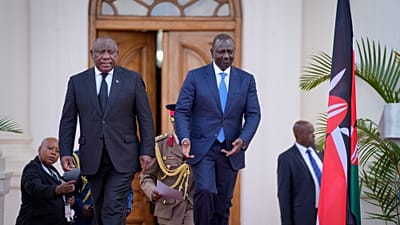
Ruto made the remarks during a one-day state visit to South Africa, where he held bilateral talks with President Cyril Ramaphosa and discussed issues ranging from public health and migration to trade and regional cooperation.
Addressing concerns over the facility, Ruto said the project is being supported by the United States government with funding worth 1.8 billion Kenyan shillings and is intended to bolster Kenya’s health infrastructure.
“The American government has supported us in this Ebola set-up, infrastructure, health infrastructure, to the tune of 1.8 billion Kenyan shillings,” Ruto said.
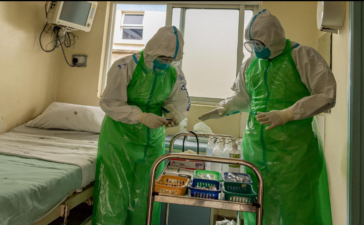
The planned facility, located about 200 kilometres north of Nairobi, will include a 50-bed quarantine unit designed to accommodate Americans who may have been exposed to the Ebola virus.
The project has sparked criticism and protests from some Kenyans, who fear that hosting individuals potentially exposed to Ebola could pose public health risks to local communities.
However, Ruto dismissed those concerns, arguing that preparedness remains the most responsible approach in light of the ongoing Ebola threat in the region.
“The Ebola situation in eastern DRC is a source of concern for any country, including Kenya that is mindful of matters health of its citizens,” he said.
“The most responsible thing to do is to prepare.”
The Democratic Republic of Congo remains the epicentre of recent Ebola outbreaks, with hundreds of infections reported. Cases have also been recorded in neighbouring Uganda, raising concerns about the possibility of cross-border transmission within East Africa.
Beyond health issues, the meeting between the two leaders also focused on migration and regional cooperation.
President Ramaphosa addressed growing concerns over anti-immigrant sentiment and sporadic attacks on foreign nationals in parts of South Africa, stressing that the government remains committed to addressing migration challenges through cooperation rather than exclusion.
He rejected claims that South Africans are inherently xenophobic and outlined plans to engage regional and international partners on migration issues.
“Yes, there will be envoys. Yes, there will be people that we will send around, not only on the continent, but also around the world,” Ramaphosa said.
“What we seek to do is to get the issue of migration broadly and properly addressed and where we should get as many key role players and countries to work together to address the challenge of migration.”
The South African leader noted that the country continues to attract migrants for economic and social reasons and emphasised the need for collaborative solutions.
“South Africa has become an oasis, an oasis of people who want to come here for a whole number of reasons. We need to be working with all other sister countries to see how best this challenge is resolved,” he added.
The visit also highlighted the growing economic relationship between Kenya and South Africa.
Both leaders praised the strong trade partnership that has developed over the past three decades and reaffirmed their commitment to strengthening bilateral relations.
As part of the visit, Kenya and South Africa signed six new agreements aimed at deepening cooperation in key sectors, including trade, maritime transport, education and cultural exchange.
The agreements are expected to boost economic collaboration, facilitate knowledge sharing and create new opportunities for businesses and institutions in both countries.
Kenya remains South Africa’s largest trading partner outside the Southern African Development Community (SADC) region, with annual trade flows between the two nations exceeding $675 million.
Analysts say the latest agreements could further strengthen economic integration between East and Southern Africa while enhancing diplomatic and strategic cooperation between two of the continent’s leading economies.
The state visit underscored the importance both countries place on regional collaboration as Africa navigates public health challenges, migration pressures and economic development opportunities in an increasingly interconnected environment.