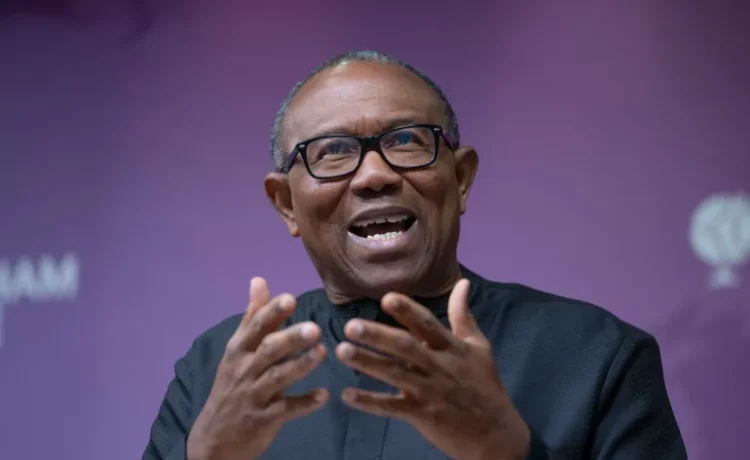
The battle for control of Nigeria’s opposition vote is intensifying as Peter Obi maintains his presidential bid while Rabiu Kwankwaso increases pressure on Atiku Abubakar to withdraw, raising doubts about whether an opposition unity arrangement can still be achieved before the 2027 election.
Obi, presidential candidate of the Nigeria Democratic Congress, has said he cannot personally decide to step down for Atiku, arguing that any such arrangement would now have to be determined by the political parties involved.
Kwankwaso, Obi’s running mate, has gone further by publicly urging Atiku to withdraw from the presidential contest.
The disagreement has become increasingly important now that INEC has formally listed both men as presidential candidates.
Atiku and Obi Now Represent Different Tickets
The final INEC list confirms Atiku as the ADC candidate with Rotimi Amaechi as running mate.
Obi is running for the NDC alongside Kwankwaso.
That arrangement creates a familiar strategic problem for the opposition.
Tinubu won the 2023 election against an opposition divided principally between Atiku and Obi, alongside Kwankwaso and other candidates.
Ahead of 2027, opposition leaders attempted to avoid a repeat.
A major gathering in Ibadan earlier this year produced a commitment to work towards one presidential candidate capable of confronting the APC.
Those ambitions have not translated into a unified ticket.
Coalition Politics Meets Presidential Ambition
The difficulty is straightforward.
Building a coalition requires politicians to cooperate.
Building a single presidential ticket requires some of those politicians to surrender their own ambitions.
That second step has proved much harder.
Channels Television noted in an analysis of the opposition crisis that the central question is no longer whether opposition politicians can meet or cooperate, but who leads, how the candidate is selected and what other blocs receive for stepping aside.
Those negotiations become more difficult once INEC publishes final candidate lists and campaigns develop their own momentum.
Tinubu Could Benefit From Fragmentation
The APC is likely to welcome the continued division.
A fragmented opposition can allow a governing party to win even when significant numbers of voters are dissatisfied, provided the opposition vote is divided among multiple credible candidates.
That does not guarantee Tinubu victory.
Obi and Atiku each have different regional and demographic strengths, and a multi-candidate contest can produce unexpected voting patterns.
But opposition fragmentation changes the mathematics.
The strategic question is whether either candidate believes he can independently build the national coalition required to defeat an incumbent president.
Four Months to Election
With the presidential election scheduled for January 16, the opposition has limited time to resolve its strategic dilemma.
Campaigns require money, organisation, candidate branding and grassroots mobilisation.
The longer Atiku and Obi campaign independently, the more difficult it becomes to persuade supporters of one candidate to suddenly transfer allegiance to another.
Nigeria could therefore be heading towards another presidential election in which the APC faces multiple opposition power centres rather than a single challenger.
The coalition debate may continue.
But INEC’s final list has transformed it from a theoretical political conversation into a rapidly closing strategic window.