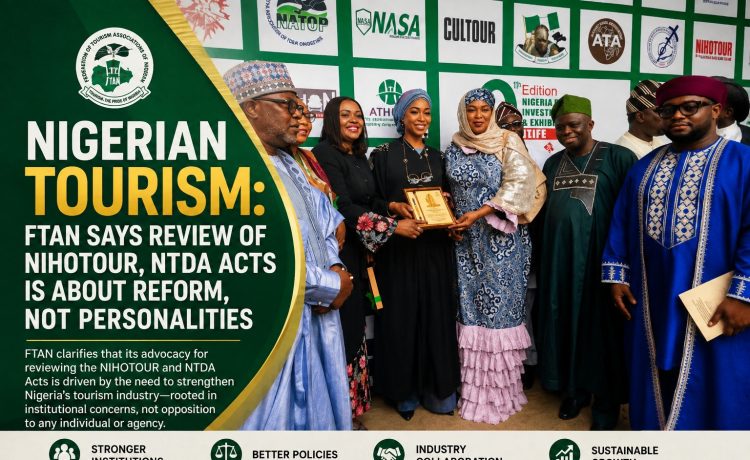
The Federation of Tourism Associations of Nigeria (FTAN) has clarified that its ongoing advocacy for the review of the National Institute for Hospitality and Tourism (NIHOTOUR) Act 2022 and the Nigerian Tourism Development Authority (NTDA) Act 2023 is driven by institutional concerns and the need to strengthen Nigeria’s tourism industry, rather than opposition to any individual or government agency.
The Federation said its position is rooted in its responsibility to promote a tourism sector supported by sound policies, effective regulation and legislation that reflects the realities of operators, investors, practitioners and other stakeholders.
According to FTAN, the debate surrounding the two laws has wider implications for the structure, regulation and future development of Nigeria’s tourism and hospitality industry.
“At the heart of the ongoing conversation in the industry is the call for a review of the NIHOTOUR and NTDA Acts and what those laws mean for the structure, regulation and development of Nigeria’s tourism industry today,” the Federation stated.
FTAN made the clarification in a statement signed by its President, Dr Aliyu Ajayi Badaki, following a recent commentary by Frank Meke, which the Federation said misrepresented its position on developments involving NIHOTOUR, its Director-General, Dr Abisoye Fagade, and the National Committee on Industry Professional Bodies Recognition and Governance.
The Federation maintained that while individuals and media practitioners have the right to express their opinions on matters affecting the tourism industry, public discourse should be based on facts, due process and an accurate understanding of the positions of relevant stakeholders.
Institutional concerns, not personal attacks
FTAN rejected suggestions that its concerns amount to opposition to NIHOTOUR or its leadership.
“For the avoidance of doubt, FTAN’s concerns are not personal and should not be reduced to an opposition to any individual or institution,” the Federation said.
It explained that its interventions are informed by its responsibility to protect the interests of its member associations, tourism practitioners, investors, businesses and the wider tourism industry.
As the umbrella body representing private-sector tourism operators, FTAN said it has both the right and responsibility to seek clarification whenever policies, regulatory initiatives or government processes could have implications for tourism businesses and professional associations.
The Federation argued that responsible industry advocacy cannot mean remaining silent whenever stakeholders have legitimate concerns about government policy or regulatory processes.
It also stressed that questions surrounding the recognition and governance of professional bodies are matters of institutional importance that require careful consideration, consultation with affected stakeholders and compliance with existing laws and regulations.
FTAN defends its advisories
The Federation also addressed criticism of its recent advisories and cautions to members, stakeholders and the general public.
According to FTAN, issuing advisories is a legitimate mechanism through which an industry body communicates concerns about developments that may affect its members and the wider sector.
The organisation rejected descriptions of its interventions as a “cycle of advisories, cautions and boycott threats,” insisting that such communications are intended to ensure that stakeholders are adequately informed.
“Where the Federation issues an advisory, it does so because it believes that its members and stakeholders deserve to be properly informed about developments that could affect their operations and professional interests,” it stated.
FTAN further argued that seeking clarification from a government agency should not automatically be interpreted as confrontation.
It maintained that questioning government policy is part of responsible stakeholder engagement, particularly where proposed regulations or administrative processes could have significant implications for an industry.
Dialogue remains central
The Federation also dismissed suggestions that it has deliberately avoided media scrutiny.
It said it has consistently participated in stakeholder meetings, industry events and engagements involving government agencies and other stakeholders.
However, FTAN noted that not every disagreement needs to be conducted publicly, stressing that dialogue, consultation and institutional engagement can sometimes produce better outcomes than prolonged media exchanges.
The organisation said its preference is to pursue constructive engagement where possible while reserving its right to publicly clarify its position when it believes its stance has been misrepresented.
No personal dispute with NIHOTOUR leadership
FTAN was particularly critical of attempts to personalise what it described as an institutional debate by framing its position around NIHOTOUR’s Director-General, Dr Abisoye Fagade.
The Federation said Fagade, like every public officer, has the right to perform his official duties, while stakeholders equally have the right to question policies and processes where they believe clarification or wider consultation is necessary.
FTAN also stated that it has no personal issue with Prof. Wasiu Babalola, stressing that its concerns relate to the mandate, composition, procedures and expected outcomes of the committee responsible for professional bodies’ recognition and governance.
“These are issues that should be addressed through facts and transparent engagement rather than speculation about personalities or motives,” the Federation maintained.
Calling for deeper reforms
Beyond the immediate disagreement, FTAN said it is interested in finding lasting solutions to what it considers structural challenges within Nigeria’s tourism regulatory framework.
The Federation expressed concern that the implications of the NIHOTOUR Act and the 2025 regulations could become obscured by broader narratives around reforms and professionalism if stakeholders do not critically examine their provisions and potential impact on the industry.
FTAN argued that genuine reform must be inclusive and should involve meaningful consultation with the practitioners and organisations that will ultimately operate within the regulatory framework.
“The tourism industry deserves solutions,” the Federation stated, adding that sustainable solutions cannot be achieved by dismissing legitimate concerns or portraying stakeholder advocacy as confrontation.
According to FTAN, achieving meaningful progress will require mutual respect, consultation, transparency and a willingness by all parties to listen.
Tourism industry needs collaboration
FTAN reaffirmed its willingness to work with NIHOTOUR, the Federal Ministry of Art, Culture, Tourism and the Creative Economy, the National Tourism Development Authority, professional associations and other stakeholders to strengthen Nigeria’s tourism sector.
The Federation said it remains committed to policies and initiatives capable of promoting professionalism, attracting investment, creating jobs and supporting sustainable growth across the tourism and hospitality value chain.
Its latest position therefore seeks to shift the conversation away from personalities and toward the broader question of how Nigeria can build a tourism regulatory environment that is transparent, effective and aligned with international best practices.
“Our doors remain open to dialogue,” FTAN said.
“But dialogue must be based on facts, mutual respect and due process—not personalisation of institutional disagreements.”
The statement underscores FTAN’s position that its campaign for a review of the NIHOTOUR and NTDA Acts should be viewed within the wider context of industry development and regulatory reform, rather than as a dispute with particular individuals or institutions.