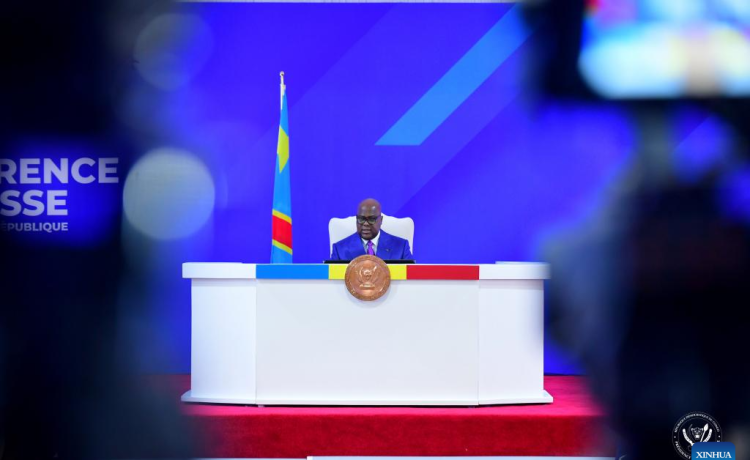
The Democratic Republic of Congo is entering an increasingly sensitive political period as President Félix Tshisekedi’s constitutional reform agenda fuels a growing debate over the country’s political future and the presidential succession expected in 2028.
Tshisekedi is constitutionally expected to leave office in 2028 under the current framework. However, proposed changes to the constitutional process have generated concern among opposition groups, which fear that reforms could eventually create an avenue for extending the president’s time in power.
The government has rejected the interpretation that the reform process is simply an attempt to extend presidential tenure, presenting constitutional reform as a broader institutional exercise.
The referendum question
The political confrontation intensified after parliament passed legislation establishing conditions under which a referendum could be organised.
The Constitutional Court subsequently ruled that the legislation complied with the constitution, although it raised concerns about some provisions.
On August 10, Tshisekedi asked the presidents of the National Assembly and Senate to reconsider the legislation in light of the court’s observations.
The National Assembly is expected to consider the matter during its September session.
This process has become the centre of a much larger political argument.
Why the opposition is concerned
Opposition groups argue that constitutional reform should not be used to weaken existing safeguards on presidential tenure.
The C64 coalition, whose name refers to Article 64 of the Congolese Constitution, has emerged as one of the main groups opposing the reform process.
Article 64 calls on citizens to oppose anyone who attempts to seize power in violation of constitutional provisions.
C64 has announced plans for nationwide mobilisation, including demonstrations expected in Kinshasa.
The opposition’s concern is therefore not limited to the specific legislation currently under consideration.
It is about what the process could eventually allow.
A political dispute during wartime
The constitutional debate is unfolding against the background of conflict in eastern Congo.
The M23 rebel movement and its allies have seized significant territory, including Goma and Bukavu.
The Congolese government has accused Rwanda of supporting M23, an allegation Kigali denies.
The conflict creates another complication for the 2028 political transition.
Tshisekedi has warned that organising elections could become difficult if fighting continues and parts of the country remain outside government control.
This raises questions about how political institutions will function if insecurity persists.
The danger of institutional uncertainty
Constitutional disputes can have significant consequences for investor confidence.
Businesses depend on political stability when making long-term investment decisions.
Infrastructure projects, mining operations and manufacturing facilities often require billions of dollars and years of planning.
Investors therefore want to know that political institutions will remain predictable.
The DRC is particularly important because of its enormous mineral wealth.
The country is one of the world’s major sources of cobalt and an important producer of copper.
Political uncertainty could therefore have consequences beyond domestic politics.
Opposition mobilisation
The planned September mobilisation indicates that the constitutional debate could become increasingly visible.
Large demonstrations could increase pressure on the government.
At the same time, prolonged political confrontation could deepen divisions within the country.
The government faces the challenge of pursuing institutional reform while convincing the public that the process is not designed to undermine democratic safeguards.
The 2028 question
Although the presidential election is still more than two years away, the succession debate has already begun.
That is partly because constitutional changes can take significant time.
Any reform affecting presidential powers or election procedures could have long-term consequences.
For the DRC, the challenge is ensuring that constitutional reform strengthens institutions rather than becoming a source of political instability.
The coming months will therefore be critical.
Parliament’s September deliberations, opposition mobilisation and the government’s response could determine whether the constitutional process develops into a negotiated reform programme or a deeper political confrontation.
For a country already facing armed conflict in its east, the stakes are exceptionally high.