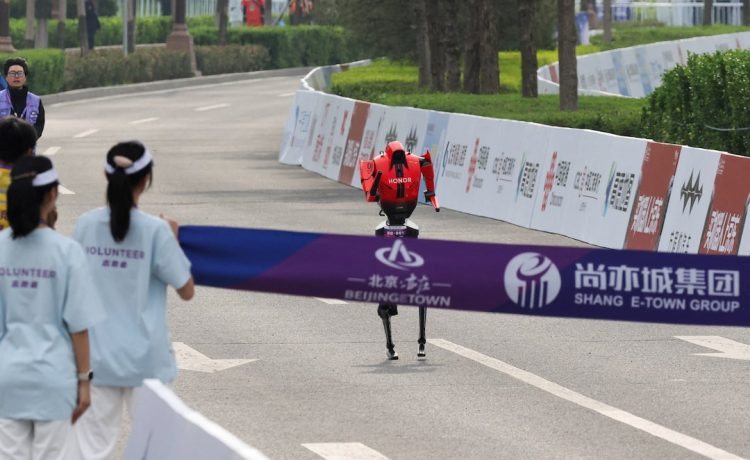
Dozens of Chinese-made humanoid robots have competed in a half-marathon race in Beijing, showcasing significant improvements in speed, balance, and autonomous navigation, and in some cases even outperforming human runners.
The event, held on Sunday, featured robots running alongside approximately 12,000 human participants on parallel tracks designed to prevent collisions.
The race marked a major leap from its inaugural edition last year, when most robots struggled to complete the course due to technical failures and instability. At that time, the winning robot finished in 2 hours 40 minutes—more than twice the time of the human winner.
This year, however, more than 100 robot teams participated, and several humanoids demonstrated significantly improved performance, with some finishing ahead of professional human runners by more than 10 minutes.
The winning robot, developed by smartphone manufacturer Honor, completed the 21-kilometre race in 50 minutes and 26 seconds. The performance surpassed the previous human half-marathon world record set by Ugandan athlete Jacob Kiplimo.
Honor robots also secured second and third place, with all podium finishers operating in fully autonomous mode without remote control assistance.
According to engineer Du Xiaodi, whose team developed the winning robot, the device was designed over a year and features leg structures between 90 and 95 centimetres long to replicate elite human running biomechanics. It also uses liquid cooling technology adapted from smartphone systems.
He said the achievement, while still experimental, demonstrates how robotics advancements could eventually influence broader industrial applications such as manufacturing and structural engineering.
Nearly half of the participating robots navigated the course autonomously, a notable improvement from last year’s edition where most required remote control guidance.
Spectators described the performance as a clear sign of China’s accelerating progress in robotics and artificial intelligence.
China has heavily invested in the sector, providing subsidies and infrastructure support to position itself as a global leader in humanoid robotics and AI-driven automation.
The demonstration comes amid broader national efforts to integrate robotics into public showcases, including high-profile performances during the CCTV Spring Festival Gala, where humanoid robots recently performed coordinated martial arts routines alongside human performers.
Despite the impressive display, experts caution that current humanoid capabilities remain limited in real-world industrial environments. Challenges such as fine motor control, environmental perception, and adaptability still hinder large-scale commercial deployment.
While the robots excelled in structured athletic competition, analysts note that translating such performance into factory efficiency or complex human environments remains a significant hurdle.
Nevertheless, the Beijing half-marathon has intensified global attention on China’s rapidly advancing robotics sector and its ambitions to shape the future of automation and artificial intelligence.