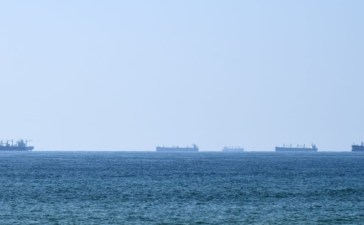
Three Liberian-flagged oil tankers were struck by unidentified projectiles while transiting the Strait of Hormuz, according to shipping intelligence service Marisks.
The incidents occurred on Tuesday and were reported by Marisks in a report released late Wednesday. The vessels were reportedly travelling through the strategic waterway with their Automatic Identification System (AIS) transponders switched off, a measure Marisks said was intended to avoid detection.
The vessels involved were the Al Ruwais, Mersin Prosperity and Sinbad. Information from maritime analytics firm Kpler showed that the vessels had been involved in oil and refined-products movements in the region.
The Al Ruwais, an oil-products tanker, was last seen conducting a ship-to-ship transfer off Suhar, Oman, in late September after discharging its diesel cargo.
The very large crude carrier Mersin Prosperity had also carried out a ship-to-ship transfer off Suhar earlier in September. Kpler data indicated that the vessel transferred about two million barrels of Iraqi Basrah crude onto another tanker.
The third vessel, the Aframax-sized Sinbad, had loaded refined petroleum products at Saudi Arabia’s Jubail industrial port earlier in September.
The latest incidents add to continuing security concerns surrounding commercial shipping in and around the Strait of Hormuz, one of the world’s most important maritime routes for oil transportation.
The Strait connects the Persian Gulf with the Gulf of Oman and the wider Arabian Sea. Large volumes of crude oil and petroleum products pass through the waterway, making any disruption potentially significant for international energy markets and shipping operators.
The identities of those responsible for the reported attacks were not immediately established. Marisks described the objects that struck the vessels as unknown projectiles.
ADNOC Logistics & Services, which manages the Al Ruwais and Mersin Prosperity, declined to comment on the incidents, while Anglo-Eastern Tanker Management, the manager of Sinbad, did not immediately respond to requests for comment.
The incidents come amid heightened tensions affecting shipping in the wider Middle East. Earlier attacks on vessels in the region have already raised concerns about the safety of seafarers, vessels and cargo moving through major maritime corridors.
For shipping companies, security risks can lead to higher insurance costs, changes in sailing routes and additional precautions for vessels operating in affected waters.
The latest incidents therefore highlight the continuing importance of maritime security in protecting one of the world’s major energy and trade routes.