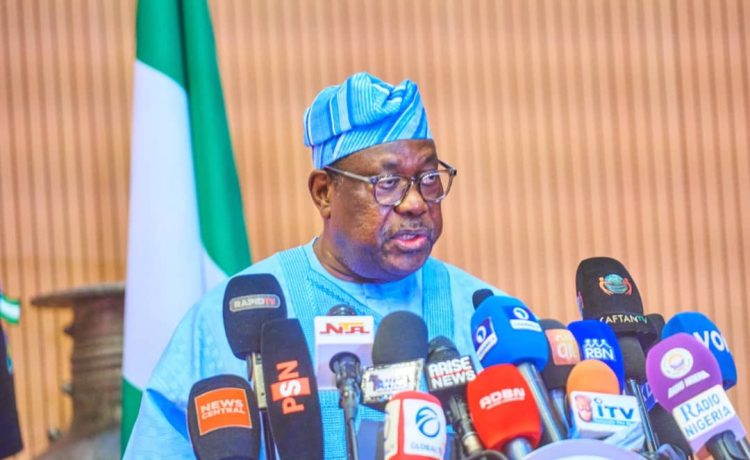
The Secretary to the Government of the Federation (SGF), George Akume, has called on Nigerians to deepen their civic responsibilities and actively safeguard the country’s democratic gains as Nigeria marks 27 years of uninterrupted civilian rule.
Akume made the appeal on Thursday during a public lecture held at the State House Conference Centre, Abuja, as part of activities commemorating Democracy Day.
Describing the anniversary as both a celebration and an opportunity for reflection, the SGF said Nigeria’s democratic journey since May 29, 1999, represents a “bond between the Nigerian state and its people” anchored on the promise that citizens’ will would form the foundation of governance.
“Twenty-seven years ago, on May 29, 1999, Nigeria made a decisive return to democratic governance,” he said. “That solemn ceremony was a bond between the Nigerian state and its people.”
He noted that a week-long programme had been organised to mark the occasion, including special Juma’at prayers, an interdenominational church service, and a world press conference, all aimed at promoting national unity and gratitude for democratic stability.
Akume also commended the National Institute for Policy and Strategic Studies (NIPSS), describing it as a key national think-tank responsible for shaping governance and leadership capacity in Nigeria.
He highlighted what he described as major gains of democracy over the past 27 years, including economic expansion, improved infrastructure, and broader access to social services such as healthcare and education through initiatives like the National Health Insurance Scheme, the Universal Basic Education programme, and the NELFUND student loan scheme.
According to him, Nigeria’s economy has grown significantly since 1999, with gross domestic product rising from about $46 billion to one of the largest in Africa, supported by diversified revenue streams and expanded financial inclusion.
He also cited major infrastructure projects, including the Lagos–Calabar Coastal Road and the Sokoto–Badagry Superhighway, as examples of democratic dividends.
However, the SGF cautioned that Nigeria’s democratic system still faces challenges, particularly in ensuring electoral integrity and strengthening public trust in governance.
He noted that while electoral institutions and the judiciary have shown improved independence over time, concerns about corruption and credibility in elections continue to affect public confidence.
“Democracy is not merely the act of voting; it is the guarantee that every vote counts equally,” Akume said.
He further warned against ethnic, religious, and regional divisions that could weaken national cohesion and democratic institutions, urging Nigerians to focus on unity and shared national purpose.
The lecture, themed “27 Years of Democratic Governance: Achievements, Challenges and the Road Ahead,” brought together government officials, policy experts, diplomats, civil society actors, and media representatives.
Akume concluded by urging citizens to see themselves as stakeholders in the democratic process, stressing that sustaining democracy requires collective effort and long-term commitment across generations.