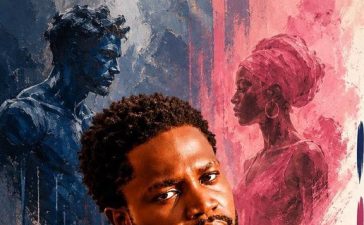
In the evolving landscape of contemporary African art, few voices capture the pulse of a generation with the clarity and emotional depth of Austin George Dorgu.
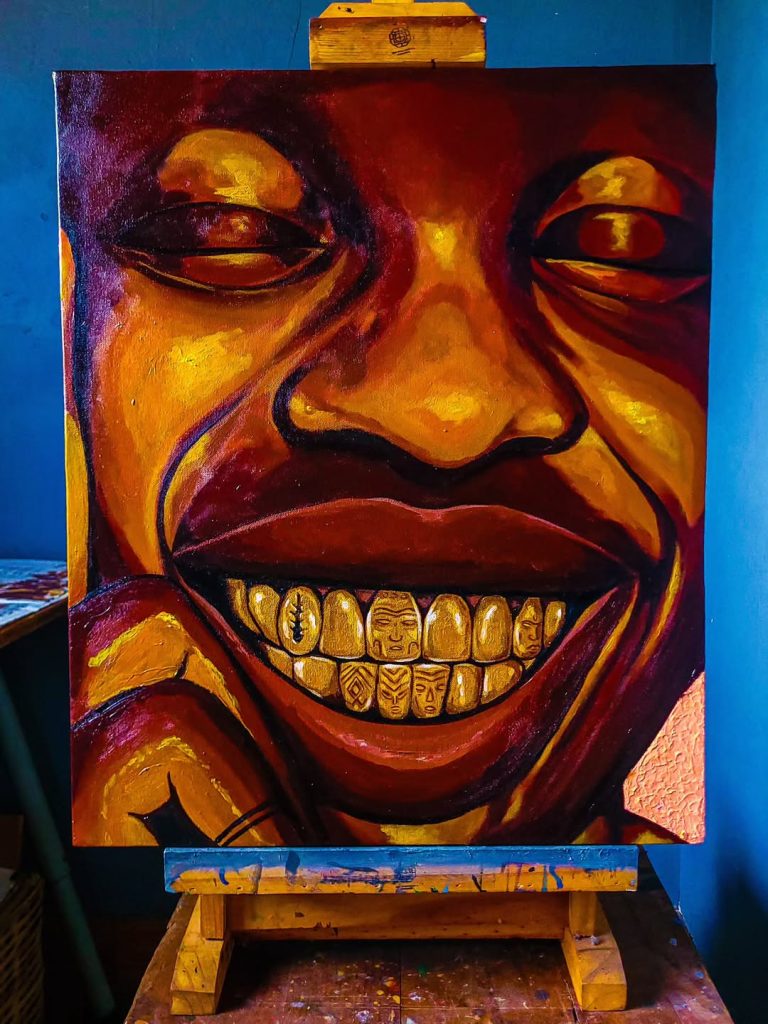
A self-taught Nigerian artist with a background in Economics, Dorgu has developed a distinctive visual language that blends figurative painting, layered textures, symbolism, and cultural storytelling to explore identity, memory, and the lived realities of modern African youth.
His work is not merely representational—it is reflective, interpretive, and deeply experiential. Through his unique approach, Dorgu positions the African youth not as passive subjects of history, but as active agents of transformation, navigating the intersection of tradition, globalization, and self-definition. Influenced by music, fashion, pop culture, and the socio-cultural rhythms of everyday life, his art becomes a space where heritage and modernity meet in continuous dialogue.
As part of the upcoming discourse around Here & Now, his practice speaks directly to themes of becoming, resilience, and belonging, offering a visual meditation on what it means to exist fully in the present while carrying the weight of memory and ancestral inheritance.
In this interview with AV1 News, Austin George Dorgu reflects on his artistic journey, the intellectual and emotional foundations of his work, and his commitment to portraying a more layered and humanised understanding of Africa’s younger generation.
AV1: Your work focuses on the vitality and aspirations of Africa’s younger generation. What inspired this focus?
Dorgu: My inspiration comes from witnessing a living culture in motion. As an artist, I don’t see our heritage as a static tribute to the past; it is a bridge built to carry living values into the future. Africa’s younger generation is the manifestation of that movement, they are the ones currently negotiating the space between memory and momentum. I wanted to capture their “inner fire,” that irreducible essence of cultural belonging and modern expression that refuses to be flattened or frozen by time.
AV1: You studied Economics before becoming a full-time artist. How has that background influenced your perspective?
Dorgu: Studying Economics gave me a structured framework for understanding human behavior, societal structures, and systems of exchange. When I transitioned to art, that analytical lens didn’t disappear; it evolved. Instead of looking at scarcity or market trends through numbers, I began looking at the “prosperity of the African spirit” and how cultural values travel and survive across generations. Economics taught me to see the macro-patterns of our world, while art allows me to explore the deeply personal, interior lives of the people navigating those systems.
AV1: As a self-taught artist, what were some of the biggest lessons you learned on your own?
Dorgu: The greatest lesson has been learning to trust a deeply intuitive process while maintaining a rigorous commitment to experimentation. When you don’t follow a traditional academic art path, you have to build your own visual language from scratch. For me, that meant discovering how to work through accumulation of layering textures, blending physical materials like sand, and exploring color relationships drawn directly from our ceremonies and landscapes. Being self-taught taught me that paint isn’t just a medium; it’s a form of transmission, and the canvas is a space where you are free to negotiate your own rules.
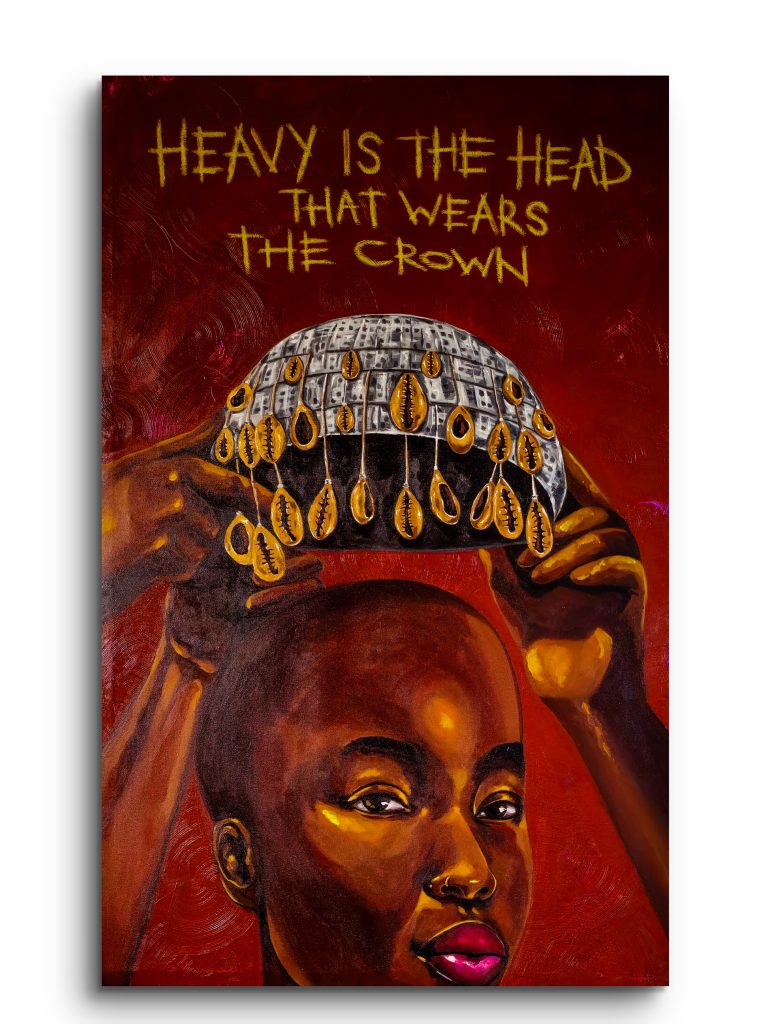
AV1: Your paintings celebrate youth as agents of transformation. What qualities of African youth inspire you most?
Dorgu: It’s their quiet defiance, their dignity, and the sheer velocity with which they occupy modern spaces. There is an incredible resilience in how young Africans carry the ancestral weight of their heritage while simultaneously redefining global trends. They possess a unique ability to honor where they come from without letting it restrict where they are going. That balance of respect for tradition and an unapologetic drive for transformation is incredibly electric to witness and paint.
AV1: Popular culture, music, and fashion often influence your work. Why are these important cultural markers?
Dorgu: They are the ultimate vehicles for cultural continuity. Music, fashion, and pop culture are how stories, spiritual truths, and communal values travel from one era to the next in the modern world. They are fluid, ever-evolving spaces where the weight of tradition meets the velocity of contemporary life. By incorporating these contemporary markers alongside deep textures and layered symbolism, I’m documenting how the youth actively reclaim and project their identity forward today.
AV1: How do you capture the energy and complexity of contemporary African life in your paintings?
Dorgu: I do it by treating the canvas as a kinetic space. My process relies heavily on layers of texture that reference our material culture, combined with intuitive color choices. I lean into portraiture not just to document a likeness, but as an invocation. By capturing the gaze, the posture, and the rich textures surrounding my subjects, I try to map their interiority and the complexity of living in a fast-paced, modern African reality.
AV1: What stories about African youth do you feel are often overlooked?
Dorgu: The world often focuses on narratives of struggle or survival, completely overlooking our profound interiority, our quiet dignity, and our inherent prosperity. History has a way of flattening our experiences. Overlooked are the nuanced, everyday stories of joy, the deep mental and spiritual spaces young Africans occupy, and the sophisticated way they blend global identities with local roots. My art aims to make felt exactly what mainstream documentation has often rendered invisible.
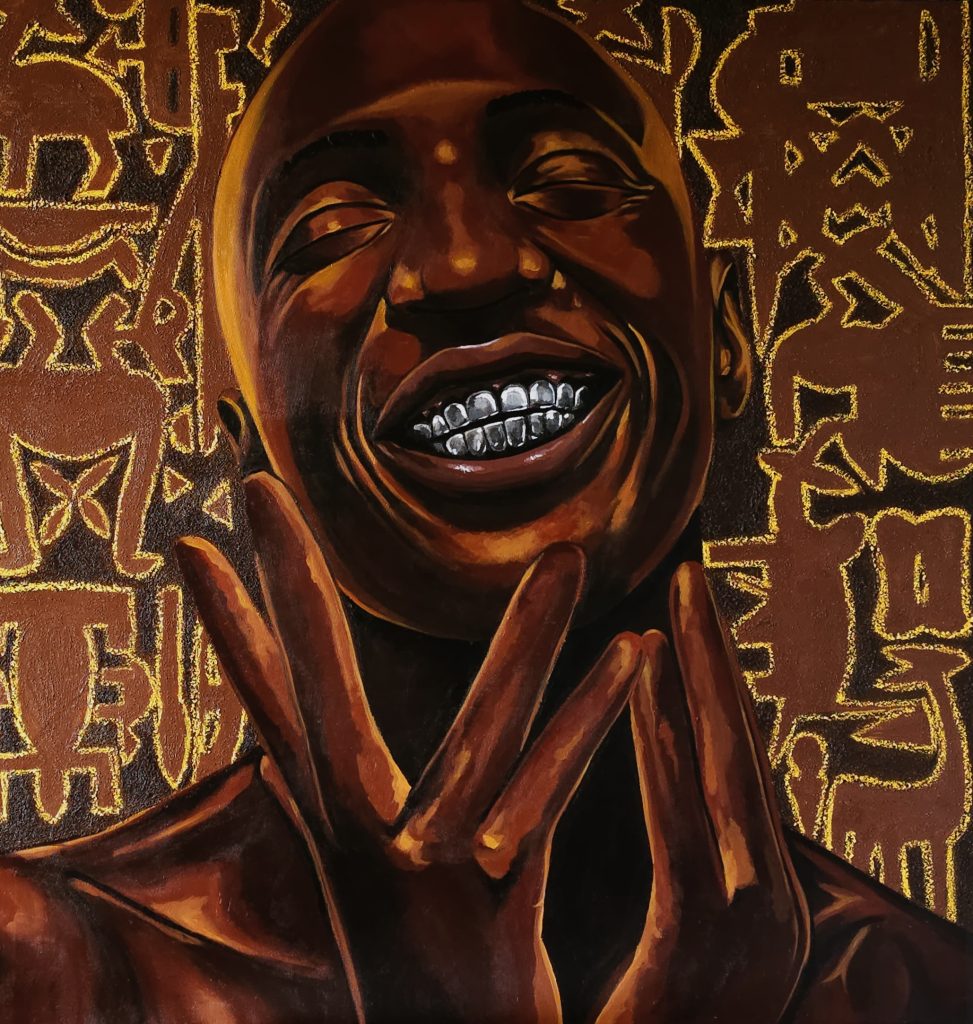
AV1: The exhibition is titled “Here & Now.” How does your work connect with the themes of becoming, identity, memory, and environment?
Dorgu: “Here & Now” is the exact intersection of memory and momentum. My work deals directly with identity and becoming by showing that who we are is a continuous act of reclamation. Memory serves as the anchor, the ancestral weight and shared heritage we carry. The environment is the canvas itself, a site of negotiation where these young subjects firmly plant themselves, declaring that they belong fully to both the rich soil of their past and the expansive possibilities of the present moment.
AV1: How do you balance optimism with the realities and challenges facing young Africans today?
Dorgu: The balance is found in the dignity of the subjects. I don’t ignore the realities, but I choose to highlight the “inner fire” that persists regardless of circumstance. To paint a young African fully rendered with complexity, beauty, and historical depth is not blind optimism; it is a political and spiritual act of resilience. It’s showing that while challenges exist, they do not define the limits of our spirit or our future.
AV1: What role does creativity play in shaping Africa’s future?
Dorgu: Creativity is the ultimate tool for projection. It has the unique power to design spaces where identity is not just remembered, but actively reimagined and reclaimed. When we create, we break free from frozen, colonial, or historical misrepresentations. Creativity allows us to write our own stories, speak our own truths, and visually manifest the prosperous future we want to inhabit.
AV1: How has your work evolved since becoming a full-time artist?
Dorgu: Since making the transition to a full-time practice in 2022, my work has become much more intentional, researched, and layered. In the beginning, it was about mastering the medium, but over the years, it has evolved into a rigorous exploration of cultural transmission. I’ve become much more invested in the tension between Western formal traditions and non-Western ways of organizing meaning, allowing my textures to become bolder and my storytelling to run deeper.
AV1: What do you hope viewers learn about modern Africa through your work?
Dorgu: I hope they realize that modern Africa cannot be flattened, frozen in time, or easily categorized. I want them to see a continent that is vibrant, complex, and intensely forward-moving. More than anything, I want viewers to walk away with a profound sense of the historical depth and beautiful complexity of the people who live here.
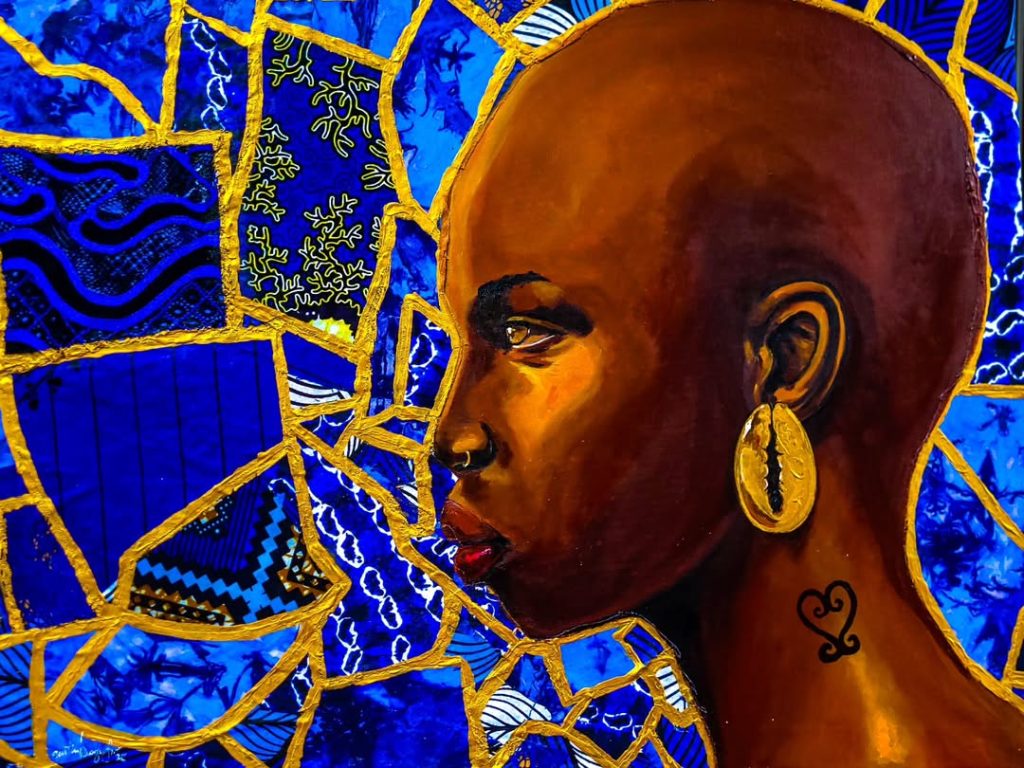
AV1: How do you see contemporary African art influencing global perceptions of the continent?
Dorgu: Contemporary African art is completely dismantling the old, singular gaze. We are moving global audiences past mere documentation and forcing them to engage with our actual depth, interiority, and nuance. By bringing our own non-Western ways of organizing meaning into global creative dialogues, we are rewriting the visual language of identity on a global scale.
AV1: What has been the most rewarding moment of your artistic journey so far?
Dorgu: The most rewarding moments are always when a viewer, especially a young African stands in front of my work and truly connects with that “inner fire”. Seeing someone recognize themselves fully rendered with dignity and complexity, and watching them feel a shared echo of heritage, is incredibly moving. It confirms that the art is doing its job as a vessel for connection and cultural continuity.
AV1: Looking ahead, what stories are you most eager to tell through your art?
Dorgu: I am eager to dive deeper into how our spiritual truths and communal values adapt as the world becomes increasingly digital and globalized. I want to continue mapping the boundless prosperity of the African spirit, finding new textures and symbols to tell the stories of our ongoing evolution, and ensuring our living values are beautifully projected into the future.