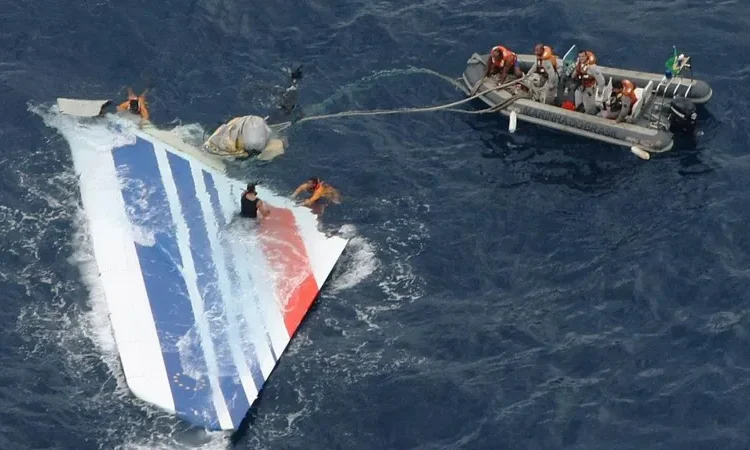
Air France and Airbus have been found guilty of corporate manslaughter by a French court over the 2009 crash of Flight AF447, which killed all 228 people on board.
The ruling was delivered by the Paris Appeals Court, which overturned a previous decision in April 2023 that had cleared both companies of responsibility.
The case stems from the crash of an Airbus A330 operating as Air France Flight AF447, which was travelling from Rio de Janeiro to Paris when it went down in the Atlantic Ocean during a storm on June 1, 2009.
The aircraft stalled mid-flight and plunged into the ocean, killing 216 passengers and 12 crew members, making it the deadliest aviation disaster in French history.
The wreckage of the aircraft was eventually discovered on the seabed after an extensive search covering about 10,000 square kilometres, while the flight’s black boxes were recovered in 2011 after months of deep-sea operations.
Following the verdict, both Air France and Airbus were ordered to pay the maximum fine of €225,000 each, equivalent to about $261,720.
However, the penalty has been criticised by some victims’ families, who described it as insufficient compared to the scale of the tragedy.
Prosecutors argued during the trial that the companies’ conduct had been “unacceptable,” accusing them of failing to adequately address known risks associated with the flight systems and storm conditions.
Both companies have consistently denied wrongdoing and are expected to consider further legal appeals following the ruling.
Relatives of victims, many of whom were French, Brazilian, and German nationals, attended the court proceedings as the verdict was announced.
The disaster triggered one of the largest aviation recovery operations in history, with Brazilian and French authorities coordinating search and recovery efforts across the remote Atlantic region, over 700 miles from the South American coast.
In the early phase of the operation, 51 bodies were recovered within the first 26 days of search efforts, with many victims still strapped in their seats.
The case continues to draw attention more than a decade later, both for its legal implications and for the ongoing debate over corporate accountability in aviation safety.