King Charles III has praised the contributions of Nigerians living in the United Kingdom, describing them as vital to the country’s development and cultural richness.
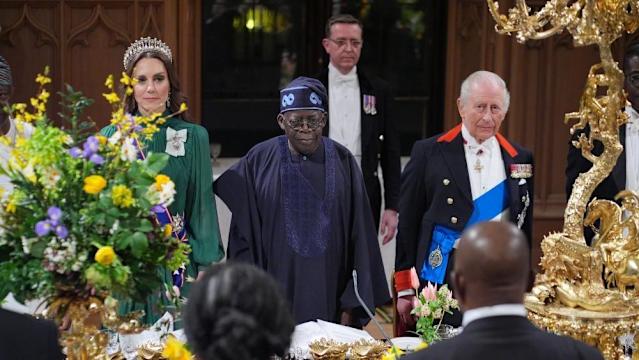
The monarch made the remarks during a royal banquet held at Windsor Castle, west of London, in honour of Nigerian President, Bola Tinubu, as part of his two-day state visit to the UK.
Speaking at the historic venue, King Charles III commended Nigerians in the diaspora for their outstanding impact across British society. He noted that many individuals of Nigerian heritage have become deeply integrated into the fabric of the United Kingdom.
“We in the United Kingdom are blessed that so many people of Nigerian heritage, having chosen Britain as their home, are now at the heart of British life,” the King said.
He further emphasised that Nigerians are excelling at the highest levels in business, technology, academia, law, science, sports, literature, and the arts. According to him, their contributions continue to drive innovation and progress across the country.
Reflecting on his personal experiences, the monarch revealed that he had met several Nigerians making quiet but meaningful contributions in various sectors. He described them as “quiet heroes” who are shaping communities through their work in schools, businesses, the National Health Service, and universities.
“I have met so many of these quiet heroes in our schools, businesses, National Health Service, and universities,” he said, adding that many young Nigerians have also benefited from initiatives under his King’s Trust over the years.
In a lighter moment, King Charles III recounted hosting members of the Nigerian diaspora at St. James’s Palace, where he joked about the famous West African dish, Jollof rice.
“Only last week, I was delighted to host a rather lively group of them to a jollof and tea party… I was firmly assured that the jollof was only the best — Nigerian, of course. Or, perhaps, it was Ghanaian or Senegalese. Diplomatically, I cannot remember,” he said humorously.
The King also reflected on his first visit to Nigeria 36 years ago, expressing admiration for how Nigerians he encountered have gone on to achieve remarkable success in the UK.
He pointed to the growing global influence of Nigerian culture, citing Afrobeats music, Nollywood films, and the presence of Nigerian talents in the English Premier League and British institutions.
“So much of Britain’s culture is in truth profoundly enriched by Nigerians,” he added, before concluding with a toast: “Naija no dey carry last.”
President Tinubu’s visit began with full ceremonial honours, including a guard of honour and a ceremonial gun salute, symbolising the enduring diplomatic ties between Nigeria and the United Kingdom.
The visit features high-level engagements with British officials and interactions with the Nigerian community in the UK. It is aimed at strengthening bilateral relations, boosting trade and investment, and enhancing cooperation in critical areas such as security and education.
Analysts say the strong presence of Nigerians in the UK remains a strategic asset in deepening relations between both nations.