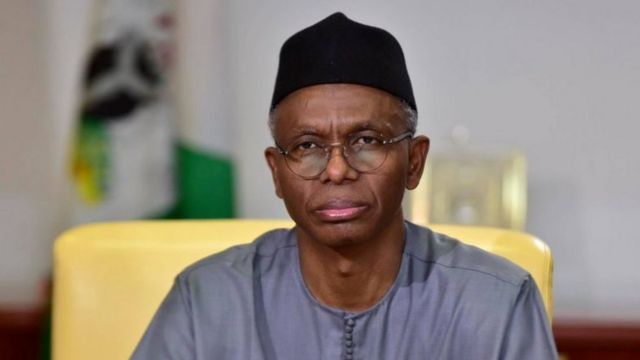
The arraignment of former Kaduna State Governor, Nasir El-Rufai, was stalled on Wednesday following his absence in court, prompting Justice Joyce Abdumalik to adjourn proceedings to April 23, 2026.
At the resumed sitting of the Federal High Court in Abuja, prosecution counsel, Oluwole Aladedoye, informed the court that although the matter was slated for arraignment, the defendant could not be produced as he was currently in the custody of the Independent Corrupt Practices and Other Related Offences Commission (ICPC).
He requested an adjournment to enable the anti-graft agency produce the defendant, noting that the Department of State Services (DSS), which filed the charges, had no control over the ICPC despite being a sister agency.
Defence counsel, Oluwole Iyamu, did not oppose the adjournment request but informed the court that the prosecution had indicated it would not oppose a bail application, as the offences were bailable.
The defence subsequently urged the court to hear the bail application before further proceedings. However, the prosecution opposed the move, seeking a two-week deferment.
Iyamu argued that continued detention without arraignment amounted to suppression, stressing that the defence did not have custody of the defendant and therefore could not produce him in court. He urged the court, relying on Section 159, to order the defendant’s production irrespective of the agency holding him.
In her ruling, Justice Abdumalik held that since the defendant had not been arraigned, the issue of bail could not arise. Citing Section 156 of the Administration of Criminal Justice Act (2015), she described the bail application as premature and adjourned the matter to April 23 for arraignment.
The DSS had, on February 16, 2026, filed a three-count charge against El-Rufai, accusing him of unlawfully intercepting the phone communications of the National Security Adviser, Nuhu Ribadu.
The charges, marked FHC/ABJ/CR/99/2026, alleged that the former governor admitted during a February 13 appearance on Arise TV’s Prime Time Programme that he and others intercepted the NSA’s communications.
The offences are said to be punishable under the Cybercrimes (Prohibition, Prevention, etc.) Amendment Act, 2024 and the Nigerian Communications Act, 2003.
Meanwhile, El-Rufai, through his lawyers, filed a motion asking the court to quash the charges, describing them as unconstitutional and an abuse of court process. He also sought N2 billion in costs against the DSS, accusing the agency of misusing the criminal justice system to harass and publicly victimise him.