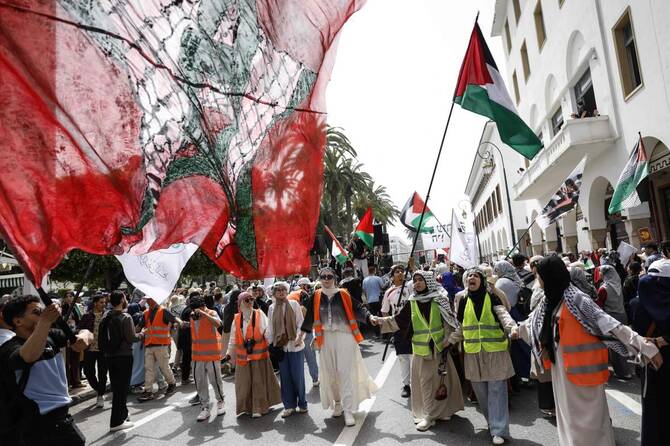
Thousands of protesters marched through the Moroccan capital Rabat on Sunday, rejecting a new Israeli law that would allow the execution of Palestinians convicted of deadly attacks.
An estimated 5,000 demonstrators gathered along Mohammed V Avenue, waving Palestinian and Moroccan flags while chanting slogans against the death penalty and Israel’s ongoing military operations in Gaza.
The protest was organised by the National Action Group for Palestine, a coalition of Islamist and left-wing organisations that includes members linked to the Justice and Development Party.
Participants said the demonstration was part of a wider grassroots movement expressing solidarity with Palestinians affected by the conflict.
“Protests and boycotts are the least we can do,” said one student participant, stressing support for detainees who could face capital punishment under the new law.
Others at the rally described the legislation as unjust, arguing that it contradicts both religious principles and international legal norms.
The controversial Israeli measure would make the death penalty the default punishment for Palestinians in the occupied West Bank convicted of carrying out deadly attacks classified as terrorism by military courts.
It also expands the application of capital punishment in certain cases within civilian courts.
The law has sparked criticism from the Palestinian Authority, human rights organisations, and several foreign governments, many of which warn it could deepen legal and political tensions in the region.
Critics argue that the legislation could create a dual justice system and potentially conflict with Israel’s constitutional and legal framework.
The protests in Rabat also highlighted opposition to Morocco’s 2020 decision to normalise diplomatic relations with Israel, with some demonstrators calling on the government to reconsider its foreign policy stance amid the ongoing war in Gaza.
The demonstration reflects continued public mobilisation across parts of North Africa and the Middle East over the conflict, which has intensified regional political divisions and drawn widespread international attention.
Organisers say further protests are expected if the situation escalates or if the law is implemented.