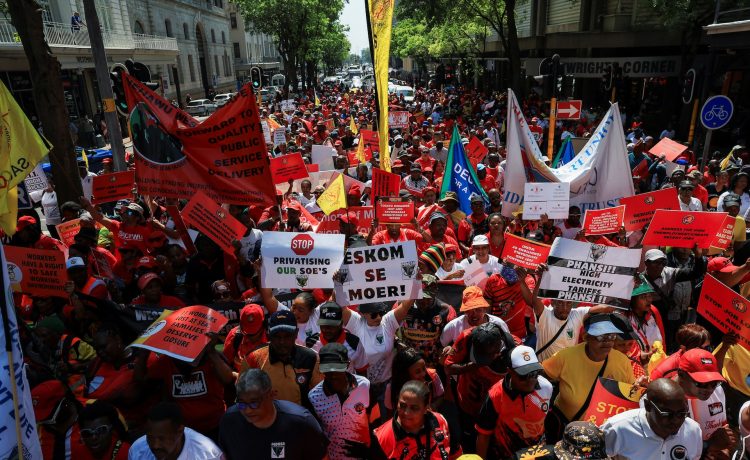
South Africa’s largest labour unions have warned workers against participating in planned anti-immigrant protests scheduled for June 30, cautioning that employees who miss work to join the demonstrations could face disciplinary consequences.
In a joint statement issued on Wednesday, four of the country’s major labour federations—the Congress of South African Trade Unions (COSATU), the Federation of Unions of South Africa (FEDUSA), the South African Federation of Trade Unions (SAFTU), and the National Council of Trade Unions (NACTU)—urged workers to remain at their jobs amid growing tensions surrounding anti-immigrant campaigns.
The warning comes as South Africa braces for a self-imposed June 30 deadline issued by anti-immigrant groups demanding that undocumented foreign nationals leave the country. The ultimatum has heightened concerns about possible civil unrest following weeks of sporadic xenophobic attacks and protests.
“We urge workers to report for duty and not place their employment at risk,” the unions said, stressing that employees who fail to attend work on the day would not be protected by labour organisations.
The labour bodies also echoed recent remarks by President Cyril Ramaphosa, who called on South Africans not to blame migrants for the country’s economic and social challenges.
“Removing foreign nationals from workplaces, communities or public spaces will not reopen factories, repair municipalities, strengthen public healthcare or create sustainable jobs,” the unions stated.
South Africa, Africa’s most industrialised economy, has long attracted migrants from across the continent due to comparatively stronger employment opportunities. However, rising unemployment, poverty, and crime have fuelled anti-immigrant sentiment, with some political figures increasingly linking these challenges to the presence of foreign nationals.
Meanwhile, reports of unrest have already emerged. South African media outlets reported clashes between police and thousands of Malawian nationals awaiting repatriation in the coastal city of Durban. According to reports, law enforcement officers used stun grenades and tear gas after crowds became agitated during the evacuation process.
The Malawian government recently disclosed that approximately 10,000 of its citizens in South Africa were seeking assistance to return home. While authorities have begun organising transport for returnees, the government has also appealed for public donations to support the large-scale operation.
“Government is resolute in its commitment to bring home every Malawian who wishes to return from South Africa,” Malawi said in a statement.
“However, the scale and urgency of the operation have created unprecedented financial, logistical, and humanitarian demands.”
Several African countries, including Ghana, Nigeria, and Mozambique, have also taken steps to repatriate citizens from South Africa amid mounting safety concerns linked to the anti-immigrant tensions.
Observers fear that the June 30 deadline could trigger further instability if tensions continue to escalate, prompting calls for calm, dialogue, and adherence to the rule of law.