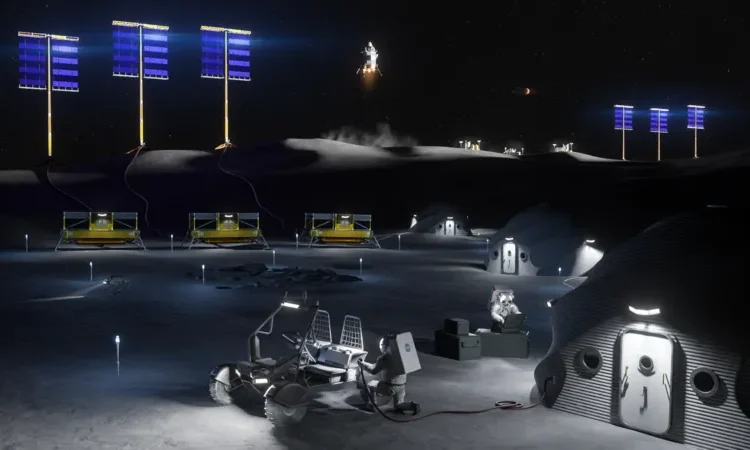
NASA has unveiled new details of its ambitious Moon Base programme, outlining plans to deploy robotic landers, hopping drones, and exploration vehicles as part of efforts to establish a semi-permanent human presence on the lunar surface.
The programme forms part of the United States’ broader strategy to return astronauts to the Moon before 2028 and build a permanent lunar base powered by nuclear and solar energy by 2032.
According to NASA, the initiative will support scientific research, resource exploration, and future missions to Mars.
The agency announced that several companies, including Blue Origin, Intuitive Machines, and Astrobotic, have been awarded contracts to build the robotic systems and delivery vehicles for the project.
The plans come amid growing competition between the United States and China over lunar exploration and long-term space dominance.
China is targeting a human landing on the Moon by 2030 and continues to expand its space ambitions through its Tiangong space station programme.
Earlier this week, China launched the Shenzhou-23 spacecraft carrying astronauts to the country’s Tiangong space station.
In March, NASA announced a $20 billion programme aimed at constructing a permanent base at the Moon’s south pole.
NASA Administrator Jared Isaacman said the latest developments demonstrate that the US will “never give up the Moon again.”
The first phase of the programme will focus on robotic exploration before humans are sent to the lunar surface.
NASA plans to deploy robotic landers and hopping drones to map the Moon’s terrain, while specialised vehicles will transport scientific instruments and communication systems.
Blue Origin’s lunar lander, known as “Endurance,” is expected to carry out precise autonomous landings and navigation tasks.
Meanwhile, Astrobotic’s Griffin-1 lander is scheduled to land near Nobile Crater at the Moon’s south pole.
The missions will also deliver advanced scientific tools, including high-resolution cameras and laser-based landing systems.
According to Moon Base programme executive Carlos García-Galán, NASA plans to conduct 25 launches and deliver four metric tonnes of cargo to the Moon before 2029.
The second phase of the programme involves building nuclear and solar-powered facilities, including fission reactors, to support long-term lunar habitation.
By 2032, NASA aims to establish semi-permanent housing that would allow astronauts to live and work on the Moon for extended periods.
The agency also plans to deploy rovers capable of travelling long distances across the lunar surface.
Scientists consider the Moon’s south pole particularly valuable because it contains frozen water deposits that could provide drinking water and oxygen for future missions.
However, experts have raised concerns about whether NASA can achieve its timeline.
Although the United States successfully sent astronauts around the Moon during the Artemis II mission in April, some scientists believe China could still become the next country to land humans on the lunar surface.
Lunar scientist Simeon Barber said delays involving spacecraft capable of safely transporting astronauts to the Moon remain a major obstacle for NASA.
“It would not surprise me at all if China gets there first,” Barber told the BBC.
A major challenge facing the programme is the readiness of SpaceX’s Starship Human Landing System, which NASA contracted for lunar landings.
The spacecraft has experienced several delays and technical setbacks during development.
“The limiting step is getting the astronauts down onto the surface,” Barber explained.
He added that political pressure linked to the renewed space race may be driving NASA’s accelerated announcements and timelines.