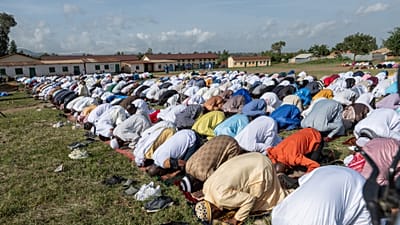
Muslims in Democratic Republic of the Congo gathered in the eastern city of Bunia on Wednesday to observe Eid al-Adha amid growing concerns over an ongoing Ebola outbreak that has heightened fear across the region.
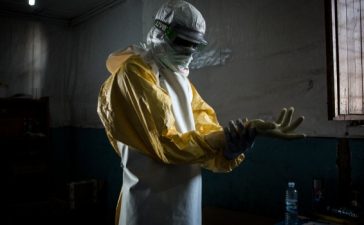
Volunteers wearing protective vests were stationed around prayer grounds, directing worshippers to wash their hands at sanitation points, while some attendees wore face masks as a precaution against the virus.
Although Muslims are a minority in Congo, larger Muslim populations are concentrated in parts of the country’s eastern region, including Ituri Province, where the outbreak has been most severe.
One worshipper, Zule Abdullah, expressed gratitude for being able to participate in Eid prayers despite the difficult situation.
“People are dying, but we thank God for his strength that has allowed us to reach this day of prayer, because this epidemic is serious. People are finding it difficult to pray,” she told the Associated Press.
The World Health Organization has classified the outbreak as posing a “very high” risk to Congo.
Health authorities said the virus spread undetected for several weeks because officials were initially testing for the more common Zaire strain of Ebola.
However, the current outbreak is linked to the Bundibugyo strain of the virus, for which there is currently no approved vaccine or treatment, making containment efforts more challenging.
Another resident, Saidati Waga, said she hoped prayers during Eid would help bring an end to the outbreak.
“God says that he has already foreseen everything, and we know that epidemics are here and will always be here,” she said.
“Those who do not accept that the epidemic is real are those who do not know.”
Health workers have faced resistance from sections of the community during response efforts.
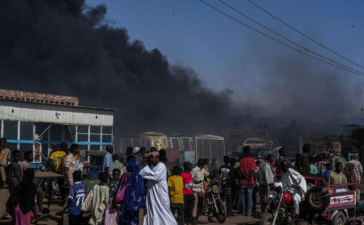
Last week, two of the three Ebola treatment centres established by aid organisations were reportedly burned down by angry residents.
In the town of Mongbwalu, residents stormed a hospital on Sunday demanding the release of the bodies of their relatives.
Alimu Yusufu, an imam and representative of the Islamic Community in Congo (COMICO), said the outbreak had greatly affected the spirit of the Eid celebrations.
“To be honest, today’s Eid is not being celebrated as usual. Because every celebration is a joy for Muslims, they gather in one place to pray and visit each other, but given the Ebola outbreak, there is a decrease in the excitement of the celebration,” he said.
The outbreak is concentrated mainly in Ituri Province, particularly in the towns of Bunia, Rwampara, and Mongbwalu.
The region has long struggled with insecurity caused by numerous armed groups operating in eastern Congo, including factions linked to the extremist Islamic State group.
The Rwanda-backed M23 rebels currently control parts of eastern Congo further south, while the Allied Democratic Forces, a Ugandan Islamist group linked to Islamic State, remains active in Ituri Province.
Although the Congolese government maintains nominal control over Ituri, security conditions remain fragile.
Before the Ebola outbreak intensified, Doctors Without Borders warned that worsening insecurity in Ituri had already forced many doctors and nurses to flee the region, further weakening healthcare services.