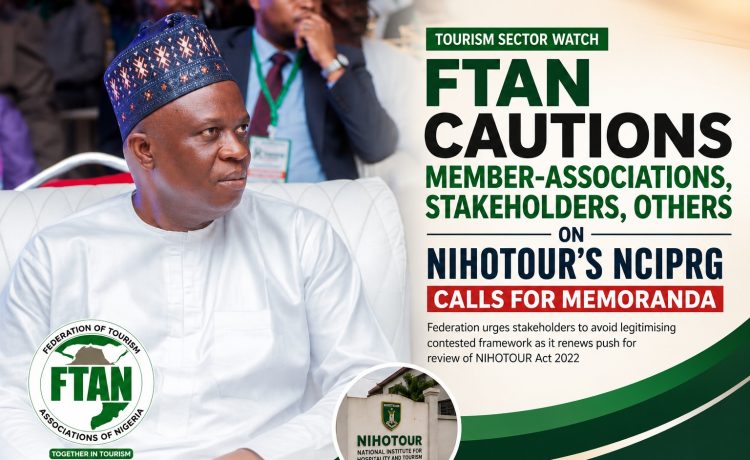
Federation warns that participation in NCIPRG memorandum process could be interpreted as endorsement of a framework whose wider implications remain unresolved
The Federation of Tourism Associations of Nigeria (FTAN) has issued a fresh advisory to tourism and hospitality stakeholders, cautioning its member-associations, practitioners, businesses, investors and professional bodies over the National Institute for Hospitality and Tourism’s (NIHOTOUR) ongoing call for memoranda through its National Committee on Industry Professional Bodies Recognition and Governance (NCIPRG).
The development comes amid FTAN’s continued campaign for a review of the NIHOTOUR Act 2022, which the federation says has raised fundamental questions about the structure, autonomy and future governance of Nigeria’s tourism, hospitality and travel industry.
In an advisory signed by its President, Dr Aliyu Ajayi Badaki, FTAN urged stakeholders to approach the memorandum exercise with caution, particularly where participation could be interpreted as acceptance or endorsement of a framework whose policy and institutional implications, according to the federation, have yet to be adequately resolved.
The intervention has added a new dimension to an ongoing debate over how professional standards, certification, regulation and industry governance should be structured within Nigeria’s tourism sector.
FTAN Questions the Process
The NCIPRG was constituted by NIHOTOUR following a stakeholders’ engagement convened in Abuja on July 15, 2026. FTAN and several of its member-associations and other stakeholders, however, stayed away from the meeting following a directive from the federation’s council.
FTAN said the engagement did not meet what it considered the appropriate threshold for a properly constituted public consultation.
The federation has now reiterated that the subsequent call for memoranda should not be viewed in isolation from the broader concerns surrounding the NIHOTOUR Act and the proposed framework for the recognition and governance of professional bodies.
The current memorandum exercise seeks stakeholder views on issues including the recognition of professional bodies, governance, certification, professional practice and collaboration within Nigeria’s hospitality, tourism and travel industry.
For FTAN, however, the process must first address fundamental questions surrounding institutional mandates and the legal framework under which tourism regulation is administered.
The federation maintains that any attempt to reshape professional governance in the sector must involve broad consultation with the recognised tourism umbrella bodies, professional associations, operators, practitioners, investors and other stakeholders across the tourism value chain.
Not Against Professionalism, FTAN Says
FTAN has sought to make clear that its opposition to aspects of the NIHOTOUR Act and the current process should not be interpreted as opposition to professionalism, regulation or higher standards in the tourism industry.
Rather, the federation argues that these objectives must be achieved through a transparent, inclusive and legally sound process that reflects the interests of the entire sector.
FTAN said it supports professional and ethical standards, competency development, continuous professional education and the recognition of legitimate professional bodies.
It also supports improved service delivery, consumer protection and stronger collaboration between government agencies, professional associations and industry stakeholders.
The federation further believes that Nigeria needs a regulatory environment capable of encouraging investment, innovation, employment creation and sustainable tourism development.
Its concern, however, is that these objectives could be undermined if regulatory and professional recognition powers become concentrated within a single institution without sufficient legal backing and industry-wide consensus.
According to FTAN, such an arrangement could result in overlapping mandates, excessive regulation and institutional conflicts.
The Bigger Question: Who Should Govern the Sector?
At the heart of the disagreement is a broader question about the future architecture of Nigeria’s tourism industry.
As the sector continues to expand, professional standards and effective regulation are increasingly important. Tourism businesses require clear rules, qualified practitioners and institutions capable of protecting consumers while supporting investment and innovation.
But FTAN argues that regulation must also respect the different interests and structures that make up the tourism ecosystem.
The federation’s position is that no single institution should assume broad professional recognition or regulatory responsibilities without a clear legal mandate and extensive consultation with the industry it seeks to regulate.
This concern is particularly significant given the existing disagreements between some tourism associations and NIHOTOUR, including legal disputes involving some FTAN members.
FTAN believes that resolving these institutional tensions is necessary before any new framework is allowed to shape the future of professional practice across the sector.
Warning Against Unintended Endorsement
One of the strongest elements of FTAN’s advisory is its warning to stakeholders about the possible consequences of participating in the memorandum process.
The federation urged its members and the wider tourism community to avoid submitting memoranda simply for the purpose of validating or legitimising a framework that remains contested.
Its concern is that participation could potentially be interpreted as broad stakeholder acceptance of the proposed Professional Recognition and Professional Practice (PRPP) framework or of an expansion of NIHOTOUR’s jurisdiction.
FTAN therefore advised stakeholders to exercise caution while the wider policy and institutional questions remain under consideration.
The federation is calling instead for a comprehensive review involving all legitimate stakeholders across the tourism and travel value chain.
A Sector at an Institutional Crossroads
The dispute comes at a time when Nigeria is seeking to strengthen tourism as a contributor to economic diversification, employment and investment.
For the industry to realise that potential, stakeholders require a regulatory environment that provides certainty rather than uncertainty over institutional responsibilities.
The debate surrounding the NIHOTOUR Act therefore extends beyond professional certification or recognition. It raises questions about how government agencies, professional associations, private operators and industry umbrella organisations should interact in regulating and developing Nigeria’s tourism economy.
For FTAN, the answer lies in a sector-wide process capable of balancing professional standards with institutional independence and industry participation.
The federation has maintained that its ultimate objective is not to weaken regulation but to ensure that regulation is structured in a manner that benefits operators, professionals, consumers and the Nigerian economy.
FTAN Calls for Dialogue
Despite its strong objections, FTAN says it remains open to engagement with the Federal Government, relevant ministries, departments and agencies, NIHOTOUR and other stakeholders.
The federation wants discussions to produce a sustainable framework that can strengthen professionalism while protecting the independence, interests and long-term growth of the tourism industry.
It has consequently urged tourism stakeholders to remain informed, united and vigilant as discussions continue.
For now, the memorandum process has become another point of contention in the wider debate over the NIHOTOUR Act 2022. Whether the disagreement ultimately leads to deeper institutional conflict or creates an opportunity for a more inclusive regulatory framework will depend largely on the willingness of the key stakeholders to return to the negotiating table.
What appears increasingly clear is that Nigeria’s tourism industry is seeking more than regulation. It is demanding a governance framework that commands confidence across the sector, provides clarity of responsibility and allows professionalism to grow without compromising the independence and diversity of the industry.