Twenty-five dance companies from across Africa gathered over the weekend in the Senegalese coastal village of Toubab Dialao for the African Dance Biennial, the continent’s largest showcase of contemporary African choreography.
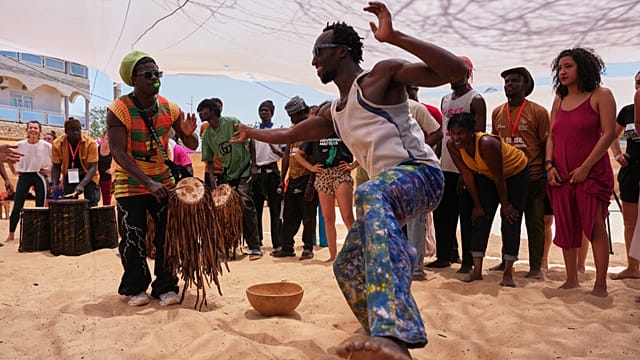
The three-day festival transformed the quiet fishing community, located about an hour from Dakar, into a vibrant open-air stage. Dozens of dancers dressed in bold oranges, greens, and blues performed barefoot on the sand, stomping, leaping, and collapsing into choreographed expressions of rhythm and storytelling.
Founded in 1997, the African Dance Biennial has spent nearly three decades rotating across African cities, including its most recent edition in Maputo, Mozambique, in 2023. The festival aims to elevate the visibility of contemporary African choreographic work on the global stage.
This year’s edition was hosted at the École des Sables, also known as the School of Sands, a leading professional dance institution founded in 1998 by renowned choreographer Germaine Acogny, widely celebrated as the “mother of African contemporary dance.”
The institution has become a cultural landmark, known for its distinctive open-air sand studio and its teaching philosophy rooted in nature. It blends Acogny’s contemporary technique with traditional West African and Black modern dance forms, attracting dancers from across the world for intensive training programmes.
The school also gained global recognition after hosting the first African production of Pina Bausch’s “The Rite of Spring,” which toured internationally between 2021 and 2025.
However, the celebrations were shadowed by uncertainty over the school’s future. A large-scale deep-water port project led by Dubai Ports World, currently under construction near the village, has raised fears of land expropriation that could affect the school’s ecosystem and surrounding cultural spaces.
Arts institutions in the area have since formed an association to resist the development, warning that the project could threaten one of Africa’s most important contemporary dance hubs.
Despite the concerns, the Biennial continued as a powerful celebration of African movement, creativity, and cultural identity, reinforcing Toubab Dialao’s growing reputation as a symbolic home for contemporary dance on the continent.