

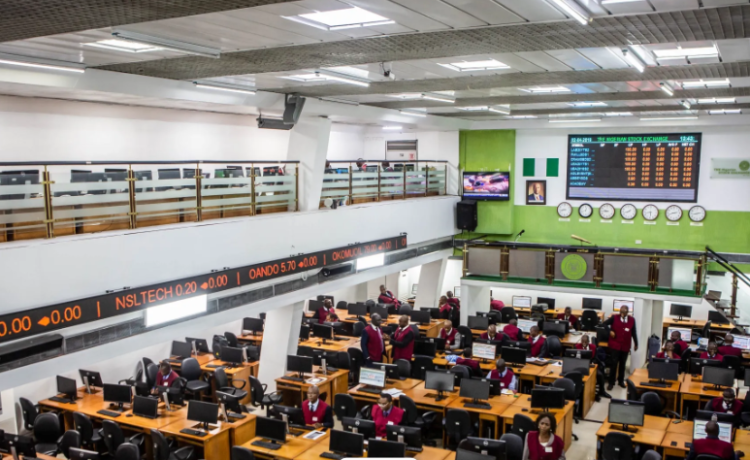
The Nigerian Exchange Limited (NGX) recorded a decline in market capitalisation of approximately ₦406.34 billion on Friday, November 20, as losses in banking stocks contributed to another negative trading session.
The decline extended the market’s losing streak to four consecutive sessions, reflecting increased selling pressure among investors.
According to market figures reported after trading closed, the NGX All-Share Index declined by 0.25 per cent, equivalent to 625.82 points, to close at 247,660.74.
Market capitalisation also dropped from approximately ₦161.21 trillion recorded on Thursday to ₦160.80 trillion at the end of Friday’s session.
The development reflected a challenging week for Nigerian equities as investors reassessed their positions amid changing market conditions.
Banking stocks were among the major contributors to the decline, with the banking index falling by 1.93 per cent.
First HoldCo recorded a decline of 4.36 per cent to close at ₦105.20 per share.
Zenith Bank also lost 2.81 per cent to close at ₦110.50, while Access Holdings declined by 2.41 per cent to ₦26.30.
The performance of banking shares remains particularly important to the Nigerian stock market because financial institutions account for a significant portion of market activity and investor interest.
When major banking stocks experience selling pressure, the impact can extend to the broader market, particularly when other highly capitalised companies also record losses.
Market performance during the week
The decline on Friday contributed to a negative weekly performance for the Nigerian equities market.
The All-Share Index fell by 1.83 per cent during the week, moving from 252,269.16 points recorded on November 13 to 247,660.74 points on November 20.
Market capitalisation also declined by 1.83 per cent over the same period.
Trading activity weakened during the week, with the value of transactions falling to approximately ₦106.36 billion from ₦185.36 billion recorded in the previous week.
The weekly market report also showed that 39 equities recorded price increases, while 43 stocks declined during the five trading sessions.
The figures indicate that negative sentiment affected several segments of the market, although some companies managed to record gains.
The insurance index gained 1.01 per cent, while the consumer goods index advanced by 0.40 per cent.
Dangote Cement and MTN Nigeria closed unchanged during the Friday session.
What is influencing investor sentiment?
Market performance is influenced by several factors, including corporate earnings, interest rates, inflation, exchange-rate movements and expectations surrounding government economic policies.
The CBN’s monetary policy meeting, which commenced on November 23, is another important development being monitored by investors.
The committee’s decision could influence the direction of interest rates and the attractiveness of different investment instruments.
Higher interest rates can make fixed-income investments more attractive relative to equities, particularly for investors seeking predictable returns.
However, changes in interest rates also affect banks, businesses and companies that depend on borrowing to finance their operations.
Investors are also monitoring the exchange rate because currency movements can influence the financial performance of companies with foreign-currency obligations or international operations.
Meanwhile, corporate earnings remain an important consideration as shareholders assess whether companies can maintain profitability under current economic conditions.
Implications for investors
The latest market decline highlights the importance of monitoring individual company performance rather than relying entirely on general market movements.
Although the market recorded losses, the performance of individual equities varied across sectors.
Some investors may view declining share prices as opportunities, while others may prefer to reduce exposure until market conditions become clearer.
However, investment decisions should be guided by company fundamentals, valuation, earnings prospects and individual risk tolerance.
The Nigerian Exchange remains an important platform for companies seeking long-term financing and investors looking to participate in the country’s corporate sector.
A stronger market performance will depend partly on sustained investor confidence, improved economic conditions and the ability of listed companies to deliver consistent financial results.
The market’s performance in the coming sessions will be closely monitored as investors await further economic data and the outcome of the CBN’s monetary policy deliberations.