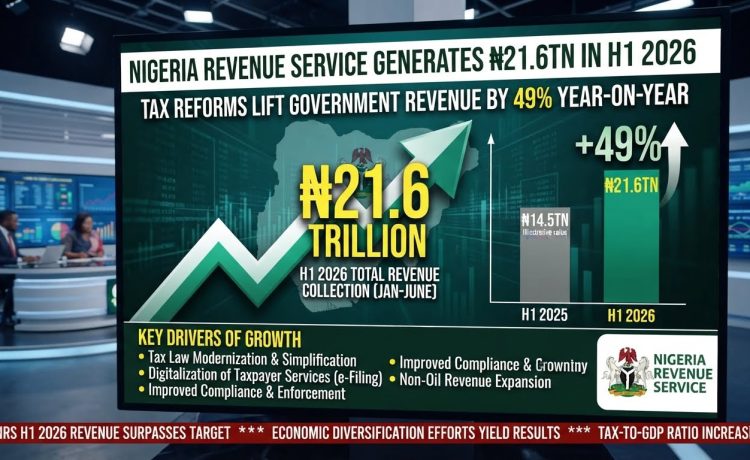
Nigeria’s ongoing fiscal reforms have yielded another significant milestone as the Nigeria Revenue Service generated ₦21.6 trillion during the first half of 2026, representing a 49 per cent year-on-year increase compared with the corresponding period of 2025.
The latest figures are contained in the Economic Snapshot Report: 2023–2026, an official assessment of Nigeria’s economic performance since President Bola Tinubu assumed office in May 2023. The report, obtained by The PUNCH, attributes the impressive growth in government revenue to sweeping tax reforms, digitalisation of tax administration and improvements in oil revenue remittances.
The report also highlights the Federal Government’s sustained efforts to broaden the country’s tax base, improve compliance and reduce dependence on crude oil earnings.
Revenue Collection Maintains Upward Trend
According to the report, Nigeria has witnessed consistent growth in tax collections over the past three years.
Total tax revenue increased from ₦12.3 trillion in 2023 to ₦21 trillion in 2024, before rising further to ₦28.3 trillion in 2025.
Within the first six months of 2026 alone, revenue collections reached ₦21.6 trillion, representing a 49 per cent increase over the same period in 2025.
The report described the performance as evidence that recent reforms are strengthening domestic revenue mobilisation while improving fiscal sustainability.
Government officials believe the trend reflects improved efficiency in tax administration as well as better coordination among revenue-generating agencies.
Non-Oil Revenue Takes Centre Stage
One of the most notable developments highlighted in the report is the growing contribution of non-oil taxes.
According to the government, non-oil revenue accounted for 76 per cent of total tax collections, underscoring Nigeria’s gradual shift away from its long-standing dependence on oil receipts.
For decades, fluctuations in international crude oil prices have exposed the country’s finances to external shocks. However, recent reforms have focused on expanding internally generated revenue through broader tax compliance and enhanced collection systems.
The report suggests that the increasing contribution from non-oil sources is helping to create a more diversified and resilient revenue structure.
Analysts have repeatedly argued that expanding the tax base, rather than increasing tax rates, offers a more sustainable path to higher government earnings.
Digitalisation Improves Tax Administration
The report attributes much of the revenue growth to the government’s ongoing digital transformation of tax administration.
Technology-driven platforms have simplified taxpayer registration, improved payment systems and strengthened compliance monitoring.
In addition, digital tools have helped reduce leakages while enabling authorities to identify previously untaxed businesses and individuals operating within the formal economy.
Government officials believe digitalisation has also improved transparency and accountability across the revenue collection process.
These reforms have encouraged more efficient tax administration while reducing opportunities for manual processing and revenue diversion.
Tax-to-GDP Ratio Shows Improvement
Another major highlight of the report is Nigeria’s improving tax-to-GDP ratio.
According to the findings, the ratio increased from 10.3 per cent to 13 per cent, reflecting stronger tax performance relative to the size of the economy.
Although the figure remains below the average recorded in many emerging and developed economies, economists consider the improvement an encouraging sign that Nigeria is gradually strengthening its fiscal capacity.
Higher tax-to-GDP ratios generally provide governments with greater financial flexibility to fund infrastructure projects, healthcare, education and other public services without excessive borrowing.
Fiscal Reforms Begin to Yield Results
The report credits the administration’s economic reforms with creating a stronger foundation for public finance.
Since 2023, authorities have introduced measures aimed at modernising tax administration, improving revenue collection efficiency and strengthening institutional coordination among government agencies.
The reforms have also been supported by changes in oil revenue remittances, helping to improve overall government receipts.
Fiscal experts note that improved revenue generation is critical as Nigeria seeks to finance infrastructure development, social programmes and economic diversification initiatives.
Greater domestic revenue mobilisation also reduces pressure on public borrowing and strengthens investor confidence in the country’s fiscal management.
Experts Call for Efficient Utilisation of Revenue
While the increase in tax collections has been widely welcomed, economists stress that sustained public confidence will depend on how effectively the additional revenue is utilised.
They argue that improved collections should translate into visible investments in infrastructure, healthcare, education, security and other essential public services.
Experts also emphasise that expanding the tax net should remain a priority, ensuring that more individuals and businesses contribute to government revenue without placing excessive burdens on compliant taxpayers.
Furthermore, transparency and accountability in public spending will remain essential in sustaining voluntary tax compliance and strengthening trust between citizens and government.
Outlook Remains Positive
The first-half revenue performance suggests Nigeria’s fiscal reform agenda is beginning to produce measurable outcomes.
If current trends continue, total government revenue could surpass previous annual records by the end of 2026.
However, sustaining the momentum will require continued investment in technology, stronger enforcement of tax compliance, policy consistency and prudent management of public finances.
As Nigeria continues its economic transformation, the latest revenue figures provide further evidence that the country’s long-term strategy of expanding non-oil revenue and modernising tax administration is gradually reshaping its fiscal landscape.
With stronger domestic revenue mobilisation, policymakers hope Nigeria will be better positioned to finance development priorities, reduce dependence on oil income and build a more resilient economy capable of withstanding global economic shocks.