The Federal Government says Nigeria is moving closer to the establishment of state police as consultations on the constitutional and legal framework for decentralised policing reach an advanced stage.
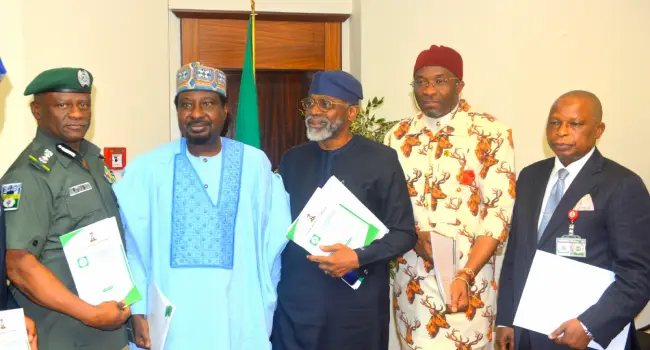
The Chief of Staff to the President, Femi Gbajabiamila, disclosed this on Thursday while briefing State House correspondents after a high-level consultative meeting on the proposed security reform held at the Presidential Villa in Abuja.
According to a statement by the Special Adviser to the President on Information and Strategy, Bayo Onanuga, discussions on the initiative began several months ago following a directive from President Bola Tinubu.
Gbajabiamila said the process involves complex constitutional and legal adjustments that cannot be rushed.
“We started deliberations in the last three or four months on how to go about the establishment of state police as directed by Mr President,” he said.
“Establishing state police is not something that you do with the snap of the fingers. There is a lot involved in terms of constitution and legalities.”
He added that significant progress has now been made in shaping the proposed framework.
“Hopefully, the amendment will come shortly, and the details of the amendment will come after that,” he stated.
Gbajabiamila explained that the immediate focus is on securing constitutional amendments, after which enabling legislation would define operational structures and responsibilities.
“Right now, what we are looking at is the constitutional amendment itself, and then the enabling law would follow thereafter,” he said.
The meeting brought together key security and legislative stakeholders, including Deputy Senate President Jibrin Barau, Deputy Speaker of the House of Representatives Benjamin Kalu, Inspector-General of Police Tunji Disu, and other senior officials.
Officials said the discussions reflect growing consensus that policing in Nigeria requires decentralisation to improve efficiency and strengthen local security responses.
Nigeria currently operates a centralised policing system under the Nigeria Police Force, controlled by the Federal Government.
However, rising insecurity, including kidnappings and violent attacks in several regions, has intensified calls for state-level policing structures.
Proponents of state police argue that decentralisation would improve intelligence gathering, enhance rapid response to security threats, and allow state governments to take greater responsibility for local safety.
President Bola Tinubu has previously described state police as a necessary step in addressing the country’s evolving security challenges and urged lawmakers to accelerate related legislative processes.
Supporters of the proposal believe it could help bridge existing gaps in security coverage, particularly in rural and hard-to-reach communities.
However, the idea has also faced criticism from stakeholders who warn that state-controlled policing could be vulnerable to political influence, abuse of power, and uneven implementation across regions.
Concerns have also been raised about funding, coordination with federal security agencies, and the potential for jurisdictional conflicts.
The renewed push for constitutional reform comes amid ongoing security challenges across parts of the country, including recent mass abductions that have heightened public concern.
Among them was an attack in Oriire Local Government Area of Oyo State on May 15, where dozens of pupils and teachers were abducted, sparking protests and renewed debate on security reforms.
Government officials say the proposed state police framework will be designed to balance local autonomy with national oversight, though full details are yet to be released.
The constitutional amendment process is expected to continue in the National Assembly in the coming months.