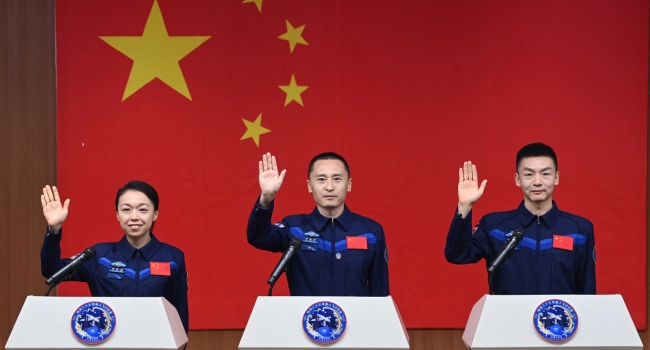
China successfully launched its Shenzhou-23 mission on Sunday, marking another major step in the country’s plan to land astronauts on the Moon before 2030.
The Long March 2-F rocket lifted off at 11:08 pm local time from the Jiuquan Satellite Launch Center in the Gobi Desert. State broadcaster CCTV showed the rocket rising into the night sky surrounded by flames and smoke.
About 10 minutes after launch, the spacecraft separated from the rocket and entered orbit successfully, according to the China Manned Space Agency (CMSA).
“The astronauts are in good condition, and the launch has been a complete success,” the agency said.
The mission is historic because it includes the first astronaut from Hong Kong. Li Jiaying, 43, previously worked with the Hong Kong police force before joining China’s space programme.
The other crew members are space engineer Zhu Yangzhu, 39, and former air force pilot Zhang Zhiyuan, 39. This is Zhang’s first trip into space.
Crowds waving Chinese flags gathered for a farewell ceremony before the launch. The astronauts saluted supporters as a military band played.
The Shenzhou-23 crew will carry out scientific experiments in life sciences, medicine, materials science and fluid physics during their mission aboard the Tiangong space station.
One of the most important goals of the mission is to allow one astronaut to remain in orbit for a full year. It will be the first time China attempts such a long-duration human spaceflight.
The CMSA said the astronaut chosen for the one-year stay will be announced later, depending on the mission’s progress.
Experts say the experiment is vital for China’s future missions to the Moon and Mars. Scientists want to better understand how long-term exposure to microgravity affects the human body.
Astrophysicist Richard de Grijs from Macquarie University said major concerns include bone density loss, muscle weakening, radiation exposure and psychological fatigue.
He also stressed the need for reliable water recycling, air supply systems and medical support during long missions far from Earth.
According to de Grijs, China is steadily building experience for long-term human presence in space through the Tiangong station programme.
Until now, astronauts aboard Tiangong have usually spent about six months in orbit before returning to Earth.
The Shenzhou-23 mission comes as China and the United States continue competing in a new space race. While NASA is pushing forward with its Artemis programme, China is developing new spacecraft and lunar technologies.
China plans to test its next-generation Mengzhou spacecraft in 2026. The spacecraft will eventually replace the ageing Shenzhou series and transport astronauts to the Moon.
Beijing also hopes to establish the first phase of its International Lunar Research Station by 2035.
China has rapidly expanded its space programme over the last three decades. In 2019, the country became the first nation to land a spacecraft on the far side of the Moon with the Chang’e-4 mission.
In 2021, China also landed a rover on Mars, further strengthening its position in global space exploration.
The country developed its own Tiangong space station after being excluded from the International Space Station programme due to US restrictions on NASA cooperation with China.